
A trailblazing partnership in South Africa has been helping to deliver transformational change for women leaders in finance

Big challenges demand bold solutions – and in South Africa, there can be no doubt about the need for bold action to create a level playing-field for women leaders.
South Africa’s top universities now produce more female than male graduates. Yet in 2023, the Commission for Employment Equity reported that women held just 26.5% of top management roles in the country.
In business, women held just 37.2% of senior management positions – with African women the most underrepresented, occupying just 5.4% of top private sector management posts. Representation was uneven in the public sector too, with women holding about 30-37% of leadership roles at municipal and local government levels.
Progress has been slow, despite leading employers’ commitments to inclusion for women in recent years. Yet change is in the air. Powerful initiatives with the potential to change South African organizations for good – and to transform women’s lives – are making a difference.
One such development is the IWFSA Fasset Women’s Leadership Programme (IFWLP), a groundbreaking partnership between the International Women’s Forum South Africa (IWFSA), Fasset – the Financial Accounting Services Seta (one of South Africa’s Sector Education and Training Authorities), and Duke Corporate Education.
This is the story of the #1000women program, and its impact in unlocking and accelerating change: change that’s benefiting not just the talented women who participated, but their employers, their communities, and even their country.
The change imperative
From the outset, the IWFLP was guided by a clear-eyed view of the challenges facing women, and by audacious, inspiring, objectives.
Nolitha Fakude is IWFSA president and chairman of Anglo American’s Management Board in South Africa. She points out that business and social structures have long tilted the tables against women. “I have lived, moved and led in spaces that were never designed for women to be… leaders,” says Fakude. The inequalities of South African society, historically and today, exert a powerful influence on women’s opportunities.
“Our journey as women is both unique and shared,” reflects Fakude. “Our experiences shape us, but it is how we support one another, the values we hold, and the legacy we create that define us.”
The drive to shape a legacy for future generations, based on shared values and support for one another, was to shape the development of the IWFLP.
Vision for leadership
The program was shaped from the very start by a strong vision of leadership. “We wanted to create a pipeline of ethical leaders – women who lead with consciousness and purpose,” explains Charmaine Houvet, senior director Africa at Cisco, a past IWFSA board member, and chair of its Leadership Development Committee when the program was initiated.
What emerged was a program focused on finance and accounting professionals in private and public sectors alike, shaped in partnership with Fasset, which funded the US$13-million program under the leadership of its CEO, Ayanda Mafuleka. “Over Fasset’s 25-year history we’ve seen vast progress – so that today, 53% of the workforce in the sector are women,” says Mafuleka. “However, they’re mainly in entrance-level or junior positions. They’re not really progressing to the C-suite or the board.”
IWFSA and Fasset identified dual challenges facing women: a “sticky floor” and a “glass ceiling.” The first speaks to the evidence that women get stuck in junior jobs longer than men; the second, to the often-invisible barriers that mean highly-qualified women are overlooked for the most senior roles. Tackling both was essential.
The analysis was aligned with a clear-eyed view of the business case for change, says Mafuleka. “The sector benefits from women’s diverse views,” she points out. “The question was, how could we elevate women’s voices and raise their confidence – to open the boardroom’s doors, and rightfully take their seats at the decision-making table?”
Shaping the Women’s Leadership Programme
Duke Corporate Education (Duke CE) was appointed as delivery partner, bringing in deep expertise in leadership development. “Duke CE was already talking about how to prepare leaders for the world of AI – for complex, volatile, uncertain environments,” reflects Houvet. “They were very forward-thinking and, most importantly, they were prepared to design the program in partnership with us.”
The approach adopted consisted of a Middle Manager Development Programme (MMDP) and an Executive Development Programme (EDP), sharing some similarities in program design but with content tailored to each career stage.
At the heart of each strand were carefully curated learning modules. For the MMDP, those included the neuroscience of leadership, leading from the middle, and brand presence, with an emphasis on confidence building, self-awareness, and influencing without authority. For the EDP, modules included working in and with boards, and future digital strategy – with an emphasis on enterprise-level strategic influence, governance and leading systems change.
The program was enriched by dialogues with industry leaders, group coaching, mentoring and global immersions. Throughout, the emphasis was on skill acquisition, the development of leadership identity, and supporting career mobility.
The program’s impact
Shirley Machaba is the current chair of IWFSA’s Leadership Development Committee, and chief executive of PwC Southern Africa. Central to the IFWLP’s impact was how it cultivated self-awareness, she argues. “Self-awareness is at the center of everything. You cannot grow if you don’t understand yourself.”
That insight was critical, given the program’s goals. “We wanted to produce leaders who lead with purpose, and that starts with your why,” she continues. As they better understood their ‘why’, so participants learned to leverage their strengths and lead with authenticity.
Mentoring relationships created through the program were incredibly powerful, with many of IWFSA’s preeminent leaders agreeing to be mentors, says Houvet. Topics included key professional challenges – navigating new roles, making an impact in the boardroom, and overcoming impostor syndrome.
But mentors also helped learners with tough personal situations. “We had women whose spouses were challenging why they were traveling, or who were going through a marriage that was falling apart. We could help source counseling,” says Houvet.
That reflected the full human realities that confront women leaders – and overcoming the challenges made those involved stronger. “Their resilience flourished as a result.”
Another priority was building learners’ networks. “The majority of the people who participated were from previously disadvantaged communities,” says Machaba. “They didn’t know where to start with networking, because they were taught to be respectful – and unfortunately, they took this respect to an extreme level.” Breaking down self-limiting instincts and instilling the confidence to build new connections was one of the program’s biggest achievements.
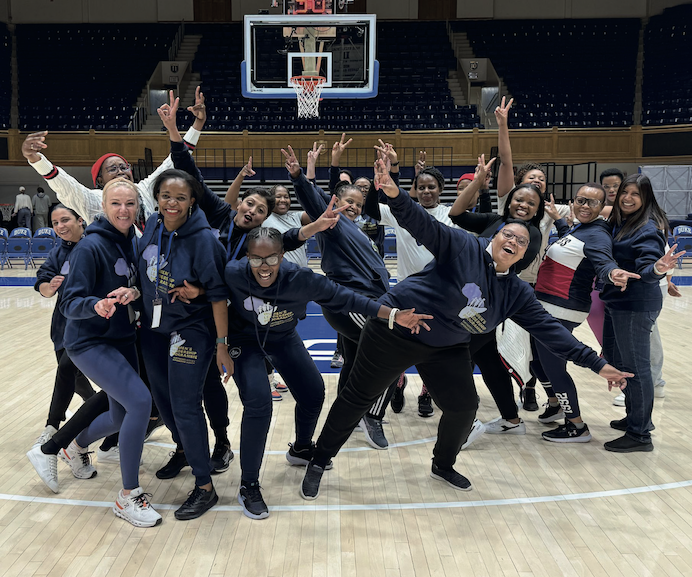
The global immersions were particularly powerful. Machaba traveled with one group to Duke CE’s hometown of Durham, North Carolina. A basketball-based activity, drawing on Duke University’s famous team, was particularly memorable. “People underestimated that!” recalls Machaba. “It develops a lot of leadership attributes and relies on teamwork. I could see our participants connecting, collaborating, working together to win.”
Houvet traveled to London. “Many of the women had never left the country – they had to apply for passports for the first time,” she notes. Visits to the stock exchange, or even the simple act of buying Tube tickets, brought earlier theoretical conversations to life. “Suddenly, debates we’d had about trade deficits, exchange rates and hedging were a lot more real,” she recalls. The effect was a massive broadening of horizons.
Stand tall, speak up, lift as we rise
The effect of the IFWLP on participants has been transformative. “It has been a life-changing program,” says Mafuleka. “These were all highly intelligent, highly capable women. They just needed this nudge – an affirmation to say, ‘You have what it takes, now go and lead.’”
“The biggest difference is how these women are now showing up in their respective spheres,” observes Houvet. “I interviewed all these applicants, and I didn’t recognize the women who graduated at the end. They walked a little taller. This program gave them the courage to find their voices.”
Machaba agrees. With 30 women at PwC South Africa participating, she has seen changes first-hand. “These women are speaking with confidence, they ask the right questions, they’re hungry for networking, and they’re intentional about what they do on a daily basis.”
Stories of the impact on individual women abound. “Within six months of the program being completed, we’ve seen so many women’s careers soaring,” says Mafuleka. About a third of women have had career progression since embarking on the IFWLP. “Some have been appointed to boards. Others have taken on new roles or even left employment to start their own business.”
One of the highest-profile alumni is program participant Dr Mampho Modise, who was appointed deputy governor of the South African Reserve Bank in 2024. She highlights the influence of IFWLP mentoring. “I am… so grateful for my mentor, who has, in such a short period of time, made a huge difference in my life and career,” reflects Modise.
The program has also succeeded in creating powerful new networks. Participants have not just learned how to network – they have gained access to their mentors’ established networks, and created myriad new direct connections. “Someone in the Treasury now knows somebody in Standard Bank, and at Investec, and so on,” points out Houvet.
With the program drawing toward its close, this network now comes to the fore. An alumni program has been established via IWFSA, with women creating new connections, opening new doors, and now mentoring others in their turn. It is a powerful dynamic that will have enduring effects. “This is the core philosophy of the program – lifting as we rise,” points out Machaba.
The energy going into this new phase speaks to the opportunity that women leaders have to support others. It is an idea that runs deep in the program’s ethos – and one that can be found in abundance in the personal values of the leaders behind the program.
“This was born of a strong personal conviction about paying it forward,” says Mafuleka. “I’m where I am because a village of women paid it forward to me. My hope is that these women go back to their organizations and multiply such programs.”
The initiative’s contribution to empowering women to influence change in their organizations and their communities is also key.
“The greatest impact of the program – besides creating inclusive economic growth – is having 1,000 advocates who are going to speak out and promote gender equality, because it’s still such a big problem,” says Machaba.
What lies ahead
The inspirational impact of the IFWLP is now fueling further work among its partners.
For Fasset, a new program is focusing on the public sector. “If we want to fix our governance in South Africa, we must support women who are in government,” says Mafuleka. The IFWLP has shown what’s possible.
“This was a much-needed investment for this country – and we can never quantify the lives changed. It is the most successful legacy program we have ever funded,” she concludes. “We are not stopping!”
IWFSA, meanwhile, is exploring ways to drive change in other sectors, while continuing to extend the influence of the #1000women in finance
and accounting. “We are going to think beyond the 1,000 – I can tell you that now,” says Machaba. The end goal? Equality. “Our wish is that we get to a stage where we no longer talk about inclusion, because everybody’s just equal,” she notes. “But it might take time.”
Ultimately, the change unleashed by the IFWLP speaks to the profound changes that face society globally in the coming years. It is an opportunity to redefine what the future of leadership looks like for women in the world of AI – and the IFWLP provides a blueprint for the future. It is proof of just how effective an ambitious, multi-part development program built around one-on-one mentorship, training, and collaboration can be.
In the meantime, growing the #1000women movement in finance and accounting remains a priority. The program’s impact has already been impressive, yet it is just the start – as the program partners underline.
Houvet points to the alumnus statement of intent: “I come as one but I stand as 1,000.” That will need to be updated, and soon. “We say 1,000 but it’s already so many more, because of those they’ve brought in. One day it may be, ‘We stand as one million – or one hundred million,’” she smiles.
Given the sheer energy and talent unleashed by this program, that day might come sooner rather than later.
Patrick Woodman is editor of Dialogue
Minor corrections were made to this article on Mar. 25, 2026
