

Unprecedented demographic changes have profound implications for individuals and organizations alike
Writing: Avivah Wittenberg-Cox

We are not just all getting older and living longer, everywhere. We are entering a fundamentally different demographic era. In just over a century, life expectancy in developed countries has increased by 30 years. Yet this miracle of science is happening at a time when fertility rates are plummeting and populations are contracting. According to the UN, by 2050, two-thirds of the world’s population will live in countries where fertility rates are below replacement level. In major economies like Japan, Germany and South Korea, the population is already shrinking.
The new demographics
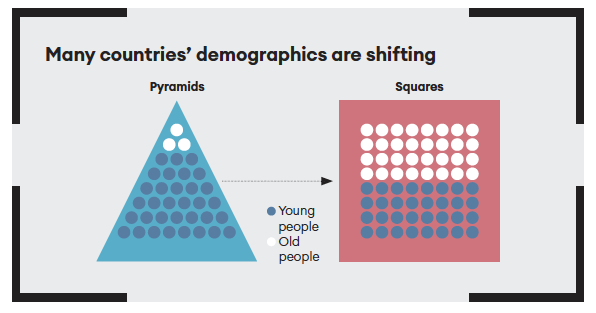
The demographic pyramid that defined the last century is flattening into a square. Once, the older-age population was a minority, supported by many more younger people of working age. In many societies, that structure is fast disappearing.
In Japan, nearly 30% of the population is over 65. In Italy, that figure is close behind. Even China, once home to a billion-strong labor force, saw its population decline for the first time in six decades. The UK Office for National Statistics now projects that by 2035, there will be more people over 65 than under 18.
The case of South Korea is particularly illustrative. It now holds the world’s lowest fertility rate, at just 0.72 children per woman – far below the replacement level of 2.1. The implications are profound: by 2100, South Korea’s population could shrink by more than half. The Seoul city government is already preparing for the closure of schools, while companies are struggling to fill jobs and maintain productivity. With fewer workers supporting more retirees, pension systems are under intense pressure, and intergenerational inequality is rising fast. South Korea is the demographic future of many developed nations – and it is arriving quickly.
At the same time, retirement ages have not shifted in line with life expectancy. Pension systems are strained. Economic growth is slowing as workforces age and contract. According to McKinsey’s recent report on the demographic economy, aging populations could reduce GDP growth by 0.4-0.8 percentage points annually in several OECD nations. This is no longer a social policy issue. It’s an economic and leadership one.
The countries and companies that thrive in this new era will be those that embrace the shift, redesign systems, and leverage the longevity dividend. Those that don’t will face labor shortages, declining consumption, and mounting intergenerational inequality. Are you ready?
Life’s four quarters: how this impacts you
The change now unfolding won’t just hit countries and companies. It will have equally profound impacts on every one of us. The old three-stage life – learn, work, retire – was built for 70-year lives. Today, half of babies born in OECD countries are expected to live past 100. That’s not a footnote. That’s a complete rewriting of the life script.
We are moving toward what I call Four-Quarter Lives, shaping a new roadmap for life.
- Q1: Grow Exploration, identity-building, education
- Q2: Achieve Career progression, family formation, financial growth
- Q3: Become Reinvention, mastery, purpose
- Q4: Harvest Mentoring, wisdom-sharing, legacy work
These quarters are not strictly chronological. They are navigational. And learning how to navigate them will become a key longevity KPI, like your heart rate or your body mass index.
I know this firsthand. I went back to school at 60 – not to start over, but to ‘Become’: to realign purpose with practice and lead from experience. Today, I work with CEOs and executive teams across the world on how to redesign macro and micro systems for our lengthening lives. And I am not alone in making big changes at this stage. It is truly the new chapter of our lives.
What’s becoming clear is that we all need to prepare for 60-year careers, not just longer retirements. That means planning not for the old success-defining linear progression, but for multiple transitions: career pivots, side ventures, periods of caregiving, returns to study, reskilling, sabbaticals and reinventions.
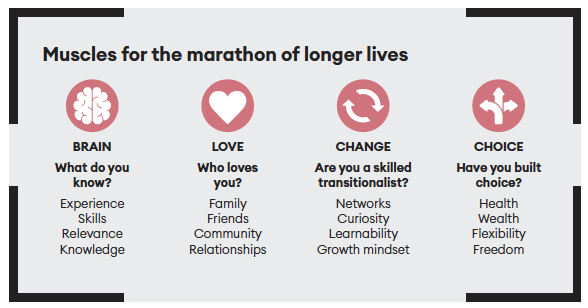
The reality is that most of us aren’t trained to navigate these transitions well. We were raised in systems built for stability, not agility. In this new era of longevity and disruption, we need to develop new personal capacities to manage change effectively. Inspired by Lynda Gratton and Andrew Scott’s book The 100-Year Life, I’ve rebranded four core ‘muscles’ that we must strengthen to thrive across the new marathon of longer lives.
1. Brain – knowledge and relevance
Do your skills and experience match the world we’re heading into? The pace of technological and social change means we’ll need to continually upgrade our minds, stay current and build relevancy muscle. Long-life learning isn’t a buzzword – it’s a survival strategy.
2. Love – relationships and community
Who do you love, and who loves you? Our personal, professional and community networks are our greatest sources of resilience and happiness in life. As we move across careers and life stages, our relationships – with partners, friends, family, mentors and colleagues – become the scaffolding of our transitions. Longevity without connection is life without air. It’s hard to breathe and grow.
3. Change – growth mindset and flexibility
Do you believe you can grow, adapt and start again? And again? The ability to embrace reinvention – to leave behind what no longer serves us and lean into something new, welcoming the ignorance and ineptitude of the beginner’s mind – is critical. Especially in Q3, the Become phase that starts around age 50, people who consciously adopt a growth mindset are more likely to find meaning, energy and purpose.
4. Choice – health and wealth as enablers
Transitions require the freedom and agency to choose. That freedom comes from being well grounded. Having enough of a foundation of health – physical, emotional and mental – and financial security that enables movement. Without these, even the best intentions remain stuck. Investing early in wellbeing and long-term financial planning opens doors when opportunity calls or disaster knocks.
These four areas – Brain, Love, Change and Choice – act as navigational supports for life transitions. Like muscles, they can be built with intention and strengthen over time. Without attention, they shrivel, just as sarcopenia eats away at our body’s muscles with age. And just like in the gym, the earlier we start training, the better prepared we’ll be for the new career marathon, with its constant pivots and adjustments.
Helping individuals build these muscles should become part of how we think about leadership development, coaching and education. This isn’t about managing decline. It’s the opposite. It’s about unlocking human potential at every stage of our lengthening lives.
Longevity leadership: how it impacts companies
Most leadership teams are not longevity-ready. They are operating with outdated assumptions about age, talent and time. Too often, strategies focus on early-career pipelines, ignoring the growing value of experienced talent, the needs of the powerful new Q3 consumer, and the power of intergenerational teams.
To prepare for the longevity economy, companies must take five strategic steps.
1. Start smart – measure the impact (and potential)
If you can’t measure it, you can’t manage it. Longevity is already reshaping your organization. But without clear metrics, its impact remains invisible. Begin with a data audit: what is your workforce’s age distribution? How does it align with your customer base? What future scenarios could demographic change create in your sector? Companies need to get smart, fast – not just about risks, but also about the massive potential. The number of indices to measure your longevity readiness is growing fast. Are longevity and demographics on your organization’s strategic radar?
Case study L’Oréal, the world’s largest cosmetics company, elevated longevity to the same strategic tier as climate change and AI. Under the leadership of Murielle Arnould, director of organization and future of work, the company launched L’Oréal for All Generations, a global program that repositions age as an asset in both workforce and marketplace. Campaigns now feature age-proud icons like Jane Fonda and Andie MacDowell flaunting grey hair – a revolution in a company that has long defined hair coloring. It is leading a global repositioning of age from invisible to aspirational.
2. Get leaders longevity-literate
Most executives have been trained for a 20th-century model of work and life. Very few are equipped to lead multigenerational teams, or design strategy for 100-year lives. It’s time to upgrade leadership curricula. That means integrating longevity-thinking into strategic planning, talent management and customer engagement – not just delegating it to HR. Senior leaders must understand the implications of age shifts on global markets and develop the language and mindset to lead across life stages.
Case study Companies from a range of sectors including CUF (healthcare), Trivalor (facility services) and Grupo José de Mello (energy and infrastructure) have sent C-suite executives to Católica Lisbon School of Business and Economics to help them get longevity literate. The School put longevity on the agenda in its advanced management program in 2023, before launching a one-week executive deep dive. Most recently, it launched the Católica Lisbon Center on Longevity, which will align the work of researchers across the university on the challenges of aging societies. It is a megatrend that needs to be better integrated in business school curricula across the globe.
3. Make cultures longevity fluent
One of the obstacles to embracing our aging futures is the profound and generalized ageism that has been baked into many cultures, especially the more youth-oriented Anglo-Saxon ones. But just adding ‘ageism’ to the list of already-overloaded DEI initiatives won’t change things fast enough. A more constructive framing of the next society is more effective. Creating a longevity-fluent culture means bypassing anti-ageism and leapfrogging immediately to more pro-aging mindsets: designing with age in mind across products, services and people systems. It’s about ensuring all generations feel understood, relevant and integrated, both as employees and as consumers.
Case study The Portuguese insurance company Fidelidade has taken a pioneering step by creating a chief longevity officer tasked with embedding longevity thinking across the business. This role ensures that age-inclusion isn’t a siloed initiative, but a strategic imperative across functions from
HR to customer experience, and brand strategy to innovation.
4. Adapt sales and marketing to four‑quarter customers
Most marketing departments are convinced the future lies with Gen Z. But what if the future consumer is old? By 2040, those over 50 will account for the majority of consumer spending in most developed countries. Yet only a small fraction of advertising and product design is targeted at them. The same shift applies to digital platforms, healthcare, education and housing. Brands need to ditch outdated assumptions about youth-centric marketing and start designing experiences that resonate with Q3 and Q4 consumers: vibrant, purpose-driven and aspirational.
Case study US company Caddis Eyewear is a lifestyle brand redefining reading glasses – and aging. With bold design, provocative messaging (“Age is the new black”), and unapologetic celebration of people in Q3, they’ve built a brand that speaks directly to the reinvention generation. Their success shows what happens when companies lean into, rather than shy away from, the longevity market.
5. Make talent management systems intentionally intergenerational
The current definition of a successful career is still embedded in the old three-stage definition of life. We need to redesign for a four-quarter workforce, keeping workforces healthy, productive and contributing across more decades. (Note that Denmark recently raised retirement ages to 70; other countries will soon follow.) That means creating age-diverse pipelines, flexible working models for different life stages, and benefits that reflect longer and more varied lives. It also means rethinking succession planning, executive development and governance, to ensure institutions reflect the demographic reality they serve.
Case study The airline easyJet made headlines with its Empty Nesters campaign to recruit older cabin crew. The campaign was wildly successful, both in business terms and in brand equity. It demonstrated that flexible, age-inclusive talent strategies can unlock new pools of experienced, enthusiastic talent. Longevity leadership is not about extending work arbitrarily or merely accommodating older workers. It is about fundamentally redesigning leadership, business models and institutions for a society in which five generations live, work and consume – together.
Leading the square
From pyramids to squares, from three-stage lives to four-quarter ones, the demographic era we’re entering demands a new kind of leadership: one that recognizes age, not as a constraint, but as a design default. Longevity isn’t a burden. It’s a business opportunity. It’s a leadership strategy. It’s the blueprint for building relevance, sustainability and growth in the decades ahead.
We must stop managing age as a risk, and start leading it as our collective future. This is us we’re talking about – something we all share.
Let’s not just add years to our lives. Let’s add leadership to our years.
Avivah Wittenberg-Cox is CEO of 20-first and author of Thriving To 100 and 5 Steps to Longevity Leadership
