
A new model offers a dynamic framework for understanding fast-changing consumer needs
Writing: Marco Robledo & B Joseph Pine II

Imagine time travelers from the 1950s landing in your living room. While your television’s technology would astonish them, the true shock would be its content: the intricate narratives, diverse characters and broadminded values unfolding on the screen that would challenge their era’s norms.
Technological advancements, societal movements and economic developments constantly reshape consumer behavior and perceptions. Sure, some changes prove superficial, but others represent a more profound evolution that alters not just what we do, but what we value, how we think, and how we view the world.
Traditionally, businesses rely on demographics and psychographics to categorize consumers. This static approach, however, fails to capture the dynamic nature of consumer evolution. We need a deeper understanding of how consumers change, to anticipate future needs, create relevant offerings and build stronger relationships.
The consumer evolution model
Stage theory, a well-established field of study in developmental psychology, explores how people mature in response to a shifting environment. It posits that individuals progress through a series of increasingly complex phases, each with distinct worldviews, values, motivations and behaviors. Think of it like leveling up in a video game. Each stage of development allows a certain range of behaviors, and when we encounter obstacles we can’t overcome, we’re pushed to grow. At this point, we have two options: stick to our existing beliefs, or move toward a more complex understanding of the world.
Numerous stage models reveal a consistent pattern, with each level building on earlier ones. Lower stages correspond to basic survival instincts, while higher stages represent increasing complexity, heightened self-awareness and expanded consciousness. Individuals may evolve from egocentric (self-focused) stages, to ethnocentric (group-focused), to world-centric (global awareness), ultimately reaching integral stages that harmonize multiple perspectives. Yet such progression is uneven, context dependent, and not universal.
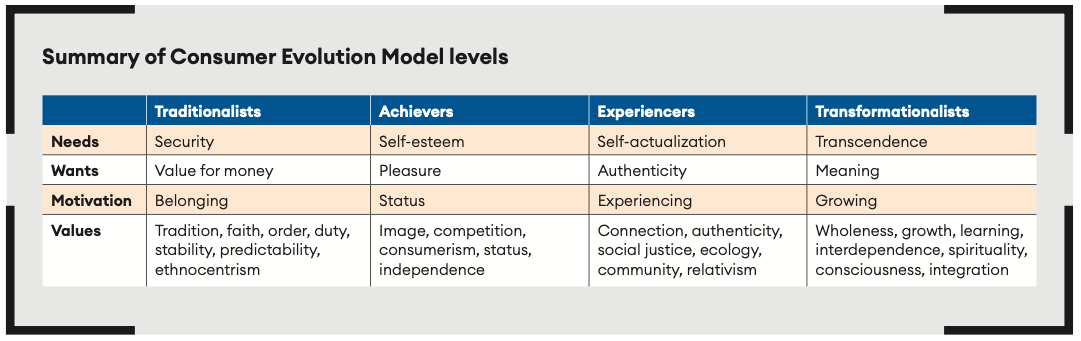
Our Consumer Evolution Model (CEM), introduced here, leverages this theory to illuminate consumer behavior. It creates a typology of how consumers mature through four different stages.
1. The Traditional Consumer
Emerging with the dawn of commerce, Traditional Consumers remained dominant until the 1960s. While often associated with seniors, traditionalists appear across demographics, today accounting for roughly 20-40% of adults in developed societies.
Characteristics:
- Conventionality and conservatism They value familiar brands, established institutions and offerings that align with traditional moral codes
- Practicality They purchase offerings based on price, availability and functionality
- Loyalty They tend to be repeat customers, comfortable with established routines
2. The Achieving Consumer
Think of the yuppies of the 1980s, when Achieving Consumers represented symbols of the economic boom. Achievers remain the largest segment today, an estimated 30-50% of the market.
Characteristics:
- Consumerist and materialistic Motivated by achievement, success and social status. They are early adopters of advanced technology and luxury goods
- Competitive They thrive in competitive environments and find themselves drawn to offerings that position them for success
- Compartmentalized They navigate distinct professional (competitive) and personal (hedonistic) selves
3. The Experiential Consumer
A growing force, Experiential Consumers are socially and environmentally aware, culturally curious, and highly interested in memorable experiences. Experientialists represent about 20% of adults, wielding significant cultural influence – and are a stark contrast to Achievers.
Characteristics:
- Experience-driven They value experiences that foster connection, personal growth and a sense of purpose over possessions
- Socially and environmentally conscious Their purchasing decisions are guided by a desire to support companies that align with their values
- Culturally sensitive Open to diverse cultures and perspectives, they value authenticity and experiences that broaden their horizons
4. The Transformational Consumer
This type represents the leading edge of consumer development. Although a smaller segment (5-10%), Transformationalists act as powerful catalysts for positive change, using consumption as a vehicle for personal growth, collective wellbeing and societal transformation.
Characteristics:
- Development-oriented They see consumption as an opportunity to consciously experiment with new ways of being and engaging with the world
- Holistic explorersThey seek practices and experiences that nurture their emotional wellbeing, physical health, intellectual capabilities and spiritual growth
- Collaborative and purpose-driven Actively engaged in cocreating a better world, they seek brands that share their passion for positive impact
Unlike broader models that track people from early life to rare stages that only represent a small portion of the population, the CEM focuses on the core customer groups that drive the economy. It is a highly dynamic landscape, with Traditional and Achieving Consumers decreasing, and the Experiential and Transformational levels growing.
Meet Sarah. Raised in a conservative small town, she embodied the Traditional Consumer – frugal and practical. College flipped the script, ushering in the Achieving stage: a lawyer craving success, designer clothes and status-marking getaways. As she matured, she entered the Experiential stage, where connection and environmental consciousness guided her choices, favoring cycling, cultural travel and value-aligned brands. Finally, Sarah reached the Transformational stage: yoga and meditation fuel her desire for self-improvement and active contribution to social causes.
By contrast, Sarah’s first boyfriend, Chris, remained in their hometown, content with familiar comfort and practicality, firmly rooted in the Traditional stage. Though both are Millennials, they ended up very different – illustrating how stage theory offers a more nuanced and useful lens than generational classification.
Consider electric vehicles (EVs). Consumers across the four stages approach EVs with distinct priorities.
- Traditionalists Motivated by environmental stewardship or reducing oil dependence
- Achievers Status is key; they view high-end EVs as symbols of success
- Experientialists Prioritize low environmental impact, ethical manufacturing and an enhanced driving experience
- Transformationalists Take a holistic, critical view, examining sustainability throughout the entire supply chain with a commitment to broader societal wellbeing.
Adapting to evolving consumer needs
The Consumer Evolution Model is a strategic compass, guiding companies toward customer-centric strategies. It is descriptive, offering myriad approaches – whether focusing on a single stage or adopting a multilevel approach. Timex is focused on Traditionalists, LVMH on Achievers, Meow Wolf on Experiencers, and many travel companies on Transformationalists – while the multilevel approach is exemplified by Marriott with its diverse brand portfolio.
To adapt successfully to evolving consumer needs, businesses must embrace four fundamental strategic shifts.
1. From a fixed mindset to an evolutionary mindset
Companies must move from reacting to changes to anticipating the dynamic nature of consumer evolution. They must become adaptive organisms capable of fluidly responding to the shifts in consumer preferences.
However, a company can only effectively serve customers at a level of complexity that does not surpass its own. Just as individuals evolve, so too do organizations (as detailed by authors such as Frederic Laloux in Reinventing Organizations, and co-author Marco Robledo in 3D Management). A company that operates primarily at a Traditionalist level, for example, will struggle to serve Achievers.
Mattel’s Barbie exemplifies this dynamic. Born in the Traditionalist era, it evolved to mirror Achiever values of career and material success. The rise of Experiential consumers brought criticism for sexism, unrealistic standards and a lack of inclusivity. Mattel’s masterful repositioning came with the 2023 Barbie movie, which transformed the brand into a feminist postmodern icon resonating deeply with Experiential consumers. Mattel’s decision to prioritize the culturally influential Experiencers proved strategically sound for brand relevance, but it was not without cost, alienating some Traditionalists – while striking Transformationalists as overly simplistic.
The lesson? You cannot please all the levels all the time.
2. From segments and personas to individual journeys
CEM is a dynamic framework, not a rigid classification system. People are not static categories. Imagine consumers as Russian dolls, each layer representing a different stage. Altered life circumstances can prompt someone to embrace earlier stages.
Conventional marketing strategies are increasingly misaligned. The CEM calls for a shift to a ‘customering’ mindset that sees each customer as a distinct individual on a unique journey, tailoring interactions to the stage they exhibit at a given moment. Consider an automotive brand aiming to meet Sarah’s evolving needs as she transitions into motherhood. To remain relevant, it could emphasize safety and reliability (appealing to Traditional tendencies), while still offering customization options that appeal to her Experiential inclinations.
3. From suppliers to guides in personal growth
Businesses can shift from being mere suppliers to active participants in their customers’ growth journeys. This involves creating the conditions for meaningful change. While many companies cannot guide transformation offerings themselves, they can equip customers with the tools, knowledge and inspiration needed. ‘Sherpa companies’ master this art, proactively shaping consumer evolution through a purpose-driven approach.
Patagonia stands as a paragon. It doesn’t just sell gear; it champions environmental activism. Initiatives like Worn Wear and its Don’t Buy This Jacket campaign encourage mindful consumption. Giving the $3 billion company to a trust dedicated to fighting climate change solidified its founder, Yvon Chouinard, as a pioneer in conscious capitalism. Consumers become members of a movement, their personal journeys intertwining with Patagonia’s purpose.
4. From goods and services to experiences and transformations
Finally, brands can shift from providing goods and services to staging enriching experiences and guiding personal transformations. Businesses should design experiences that serve as catalysts for evolutionary journeys, and transformations that help complete them.
Eataly, the Italian grocery chain, exemplifies this. Founder Oscar Farinetti didn’t just create a store; he crafted an immersive experience embodying the slow food philosophy. Each of its 40 locations worldwide is a bustling marketplace with cafes, restaurants and culinary schools where consumers learn to cook Italian meals, moving along a transformational journey. While it attracts all consumer types, for Transformationalists, it’s a destination for meaning, an entrée into slow food and the mastery of cooking.
Looking to the future of consumer evolution
The Consumer Evolution Model isn’t merely a framework for understanding current consumer behavior; it serves as a powerful lens through which to glimpse the future. The model has demonstrably tracked the shift from an Industrial Economy to a Service Economy, and, finally, to today’s Experience Economy, where consumers crave unique and memorable encounters.
However, the CEM suggests the journey doesn’t end there. We stand on the precipice of a new era – the Transformation Economy. In this emerging landscape, consumers increasingly seek not only memorable or meaningful experiences; they desire transformative experiences that catalyze personal growth, foster purposeful living and contribute to a better world. As this trend accelerates, we expect a significant rise in Transformational Consumers, with a concomitant decrease in Traditional and Achieving Consumers. Businesses should thoughtfully consider the best approach to respond to this evolution. Companies that embrace the CEM and its insights can position themselves to thrive – and those that focus on Experiencers and Transformationalists can contribute meaningfully to a more conscious and purpose-driven society.
The ever-evolving consumer presents a dynamic challenge and an unparalleled opportunity. Companies can help create the world where business and personal growth go hand in hand. It’s time to embrace the Transformation Economy by empowering individuals and making the world a better place.
Dr Marco Robledo is professor of management, University of the Balearic Islands, and author of 3D Management. B Joseph Pine II is cofounder of Strategic Horizons LLP and author of several books including The Transformation Economy
