

AI has transformative potential. But closing the gap between pilot and practice demands leadership, not just technology
Writing Tom Lawry

The future did not arrive gradually. It arrived all at once. It was the fall of 2022. Working as the national director of AI for health and life sciences at Microsoft, I had a front-row seat to what was quietly unfolding inside the world’s most sophisticated AI research organizations. Teams across Microsoft, Google, Amazon, Meta and a small, but unusually ambitious, company called OpenAI were working on large language models and generative AI systems.
At the time, none of this felt explosive. It felt incremental. Then something changed. The collective work jumped the borders of cloistered research centers and went from labs to living rooms in a matter of weeks. In the words of Hemingway, it happened “gradually, then suddenly.” Twitter took six years to reach 100 million users. TikTok took nine months. ChatGPT did it in eight weeks. Nothing in the history of human technology has moved that fast. By early 2023, it was clear the world was no longer turning on the same axis.
For healthcare, that shift arrived at a critical juncture. Aging populations, rising chronic disease and a workforce in crisis were already straining systems built for a different era. Clinician burnout had moved from a warning sign to a defining feature of the profession – the predictable outcome of asking talented people to deliver 21st-century care with 20th-century thinking and systems. AI promises a way through. The question is how.
The AI paradox: volume versus value
The adoption numbers are striking. About 70% of healthcare organizations worldwide are now actively using AI. More than eight in 10 clinicians say AI can improve patient outcomes. Measurable gains are appearing in diagnostic accuracy, workflow efficiency, administrative burden and improved access to consolidated patient data across care teams.
Yet the failure rate of AI projects in healthcare approaches 79%, according to a study by Pertama Partners. Most organizations find themselves stuck in a familiar pattern: a promising pilot that doesn’t scale. Only one-third of completed AI proofs of concept across provider, payer and pharma organizations ever make it into full production, according to a study by Bessemer Venture Partners.
This is AI theater: the visible performance of transformation without its substance. Roughly two-thirds of health organizations remain stranded between experimentation and meaningful practice, unable to move from proof-of-concept to value-at-scale.
These are not technology failures. They are leadership failures – predictable, preventable and recurring. The tools, in most cases, are sound. The question being asked of them is not.
The question that determines everything
The single variable that best predicts whether an AI initiative creates lasting value is not the technology or the strength of an algorithm. It is the orientation of the leader.
Most health leaders begin their AI journey by asking: “Is this technology ready?” This seems reasonable, but it is the wrong starting point – not because the question is unimportant, but because it directs attention, investment and accountability toward the wrong variable.
Leaders who start with the technology question typically measure progress by deployments and adoption metrics. Implementation is delegated to IT or a data science team. The C-suite watches, but does not directly drive. Frontline staff are expected to adapt. When resistance follows, it gets diagnosed as a change management problem to be managed, rather than a signal that the approach was wrong from the start.
There is a better question – one that actually predicts whether AI creates lasting value. It has nothing to do with the technology. It is simply this: “Are we ready to lead it?”
The shift from technology readiness to leadership readiness is the gap that separates organizations moving toward generating real and sustainable value from those accumulating impressive pilots that never leave the runway.
The Silicon Ceiling
The Silicon Ceiling is the gap between leadership’s excitement about AI and the workforce’s readiness to embrace and use it. Left unresolved, it becomes the invisible barrier between a well-funded AI strategy and meaningful results.
A 2026 survey of executives across all industries found that 93% identified culture and change management – not technology, not infrastructure, not budget – as the primary barrier to AI adoption and value realization. That figure has been rising for six consecutive years.
At some point, a recurring pattern stops being a warning and becomes a verdict. The verdict is this: when staff feel that AI is being done to them rather than with them, the resistance that follows is not a technology failure. It is a leadership failure. In healthcare, the stakes of this failure run deeper than in most industries. Today, the dominant feeling about AI among healthcare workers is worry, not optimism. More than half feel anxious about how AI will be used in their workplaces. About 40% fear job displacement or long-term insecurity. For clinicians, those fears extend to accountability for AI-driven errors, the devaluation of hard-won expertise, and the prospect of AI-enabled roles emerging at a fraction of the cost of human ones.
The World Economic Forum estimates that nearly 70% of workers globally will need new skills as AI reshapes the workforce. Yet only 30% say they are receiving adequate training or support to use AI effectively. That gap is replicated in healthcare: physicians report that AI is barely addressed in medical training, yet 92% say they want significantly more of it, according to a survey by the American Medical Association.
The Silicon Ceiling is not a technology problem. It is a human one, and it requires a human solution.
Empowerment, not technology
Health leaders who are generating measurable, sustained value from AI start with a premise that most technology-first rollouts overlook: innovation is a voluntary act. You cannot force people to embrace something new. You can only create the conditions that make them want to.
This means involving frontline teams before the design is complete. The goal is not to gather feedback after decisions have been made, but to make clinical and operational staff genuine co-architects of how intelligence gets applied, evaluated, and managed in their work.
When AI arrives in this context, it doesn’t feel like a system imposed from above. It feels like a capability built from within. That distinction is the structural reason some deployments generate real clinical value while otherwise comparable deployments become expensive shelfware.
Empowerment-oriented leaders look for friction before they look for tools. They map decision points inside clinical and operational workflows, where better insight could change a care outcome or a workforce experience. They ask where administrative burden is draining time from clinicians – time that belongs with patients. They identify where consumers encounter friction when they turn to the system in need.
Only after developing a clear picture of where human capability is constrained do they ask what AI can do about it. When AI is framed this way, it stops being a technology project. It becomes a workforce strategy, a patient experience strategy, and one of the most consequential competitive decisions a health system leader makes this decade.
What separates leaders who generate value
The empowerment orientation is a philosophy, not a methodology. The health systems that cross the chasm from potential to practice translate it into a consistent set of disciplines – not as a checklist but as a coherent way of leading.
Firstly, they define what success looks like before they begin. The evidence is unambiguous. According to research by Pertama Partners and Rand Corporation, 73% of failed AI projects lack executive alignment on success metrics – yet organizations that establish pre-deployment commitments achieve a 54% success rate, compared to just 12% for those that do not. The harder question is not, “What can this technology do?” but, “What specific outcomes are we committing to improve, by how much, and by when?”
Second, they treat the data estate as a strategic initiative. AI needs data like fire needs oxygen, and healthcare generates more than any other industry. The average hospital generates about 50 petabytes of data annually – more than double the holdings of the US Library of Congress. Yet less than half of structured healthcare data is ever actively used in clinical or operational decision-making, and only 5% of unstructured data is ever analyzed at all.
Next, they invest in their people as seriously as in their AI platforms. Organizations extracting real value from AI are not those that deployed the most sophisticated tools. They are those that redesign care and work with AI as a native capability, bringing their workforce along as genuine partners. That means training not as an afterthought at go-live, but as a sustained commitment woven into how the organization learns and adapts.
Fourth, they build governance before something goes wrong. Just 18% of health systems have a mature governance structure and fully formed AI strategy, yet 88% are already using AI internally, according to a study by the Healthcare Financial Management Association.
When an AI-assisted decision contributes to a patient harm event and there is no documented framework for accountability – no audit trail, no clear chain of responsibility – the organization cannot explain what happened or who is answerable. Governance must precede deployment, not follow a failure. In healthcare, the cost of learning that lesson the hard way is measured in more than dollars.
Healthcare’s intelligent future
There is another question that transformational health leaders are willing to ask: if we were building the health system from scratch today, knowing what AI now makes possible, would we build it this way? The honest answer, almost always, is no.
The future of healthcare will not arrive gradually. It is being built right now, by leaders willing to ask harder questions, take on bigger challenges, and hold themselves accountable not for the technology they deploy, but for the care they make possible. That future belongs to leaders with the courage to build it – and the conviction that, done right, AI can make healthcare better, more human, and more effective.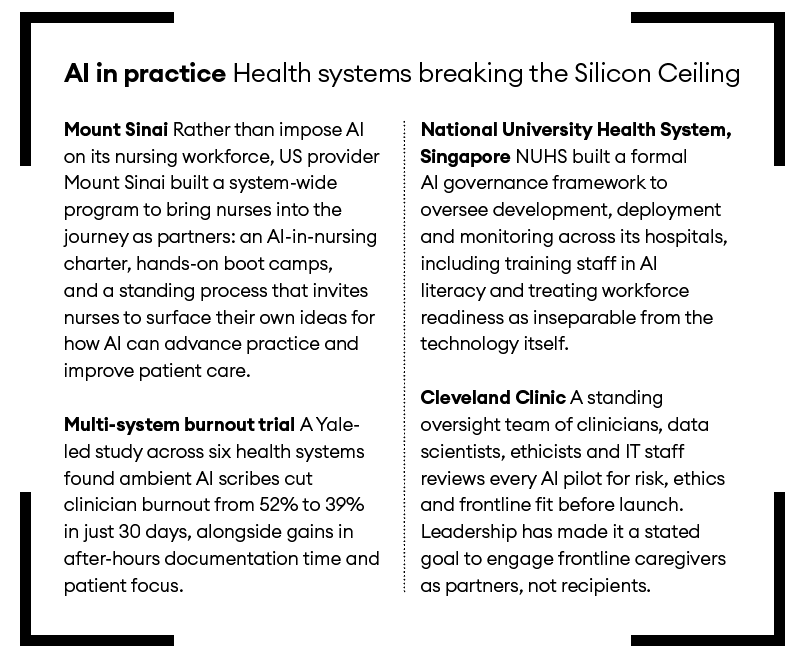
Tom Lawry is managing director of Second Century Tech, author of AI in Health and Health Care Nation, and a Duke CE educator
