

Leaders who create psychological safety reduce resistance and elevate performance
Writing: R Kendall Lyman

The current approach to change leadership is incomplete. Too many leaders are tinkering with tactics and short-term fixes while hoping for transformation and long-term improvement. All too often, they haphazardly lead change ‘on the side,’ because they are rewarded for doing their day job. In short, many leaders focus on the management of change and delegate the leadership of change.
This results in low trust, slow decision-making and high resistance. As a consequence, an estimated 70% of change initiatives fail to achieve their desired goals.
Leaders must approach change differently. Here’s how.
The emotional dimension of change
Several years ago, I helped a company with a large transformation. Over one weekend, something happened that prompted the CEO to call an all-hands meeting on Monday, where he announced a small change within the larger transformation. As he finished his explanation he added: “In this small change, in spite of what Kendall has taught us about dealing with emotions in change, we are not going to go through the emotional cycle of change.”
I was shocked. The change principles I had shared seemed to have had no impact. And I fundamentally disagreed. Leaders can’t mandate change and simply hope it will be adopted. They can’t require people to not have emotions about change. Compliance doesn’t engender commitment. Engagement comes when people feel they have a voice, that their perspectives matter, that they have some level of influence on outcomes, and they feel safe to speak up and challenge without retribution.
When people don’t feel seen, heard, understood and spoken to honestly, they fill in the gaps with stories of their own: about what the change means, the implications to them, and whether they will be able to operate in the new environment. And they worry – about how successful they will be, how their contract with the company will change, and what it means for their future.
Under these pressures, teams and individuals instinctively move into self-protection mode, filtering feedback, turning questions inward, making assumptions that may or may not be true, and withdrawing from opportunities to collaborate. People’s adoption of change isn’t something to manage; it’s something to lead.
The power of psychological safety
Efforts to lead change should focus on psychological safety, the concept that has been defined most famously by Amy Edmondson in her research. The term describes a team or workplace that is “safe for interpersonal risk-taking, [where] people feel they will not be punished or humiliated for speaking up, that they can share ideas, ask questions, raise concerns, or admit mistakes without facing negative consequences,” she explains. It enables a vital shift: from a culture of self-protection to a culture of progress.
By some estimates, mistrust doubles the cost of doing business. Values like trust and integrity translate into increased revenue and profits – often the very things leaders are trying to achieve in change. Yet whether people feel psychologically safe in the middle of unsettling transitions is dependent on their leaders’ ability to create a safe, trusting and productive environment.
When psychological safety exists, people take more ownership, release more discretionary effort and engage more in the process of improvement. The opposite also holds true. When trust is low, behaviors of self-preservation, defending the status quo and blaming others become the norm. Low-trust cultures are linked to toxic relationships, slow decision-making, low collaboration and innovation, friction between departments, interpersonal conflicts and disengaged employees. This results in low performance, increased costs and an inability to make the changes needed to maintain a competitive advantage. Stephen Covey has called this a “hidden low-trust tax.”
The bottom line? Psychological safety isn’t just about creating a ‘nice’ place to work. It directly impacts whether people stay, give their best effort and help the organization succeed. When people feel respected, trusted and safe, they don’t just work harder; they work better together.
While there are many ways to increase trust and overcome resistance, I consistently use two tools that encourage leaders to lead rather than manage change.
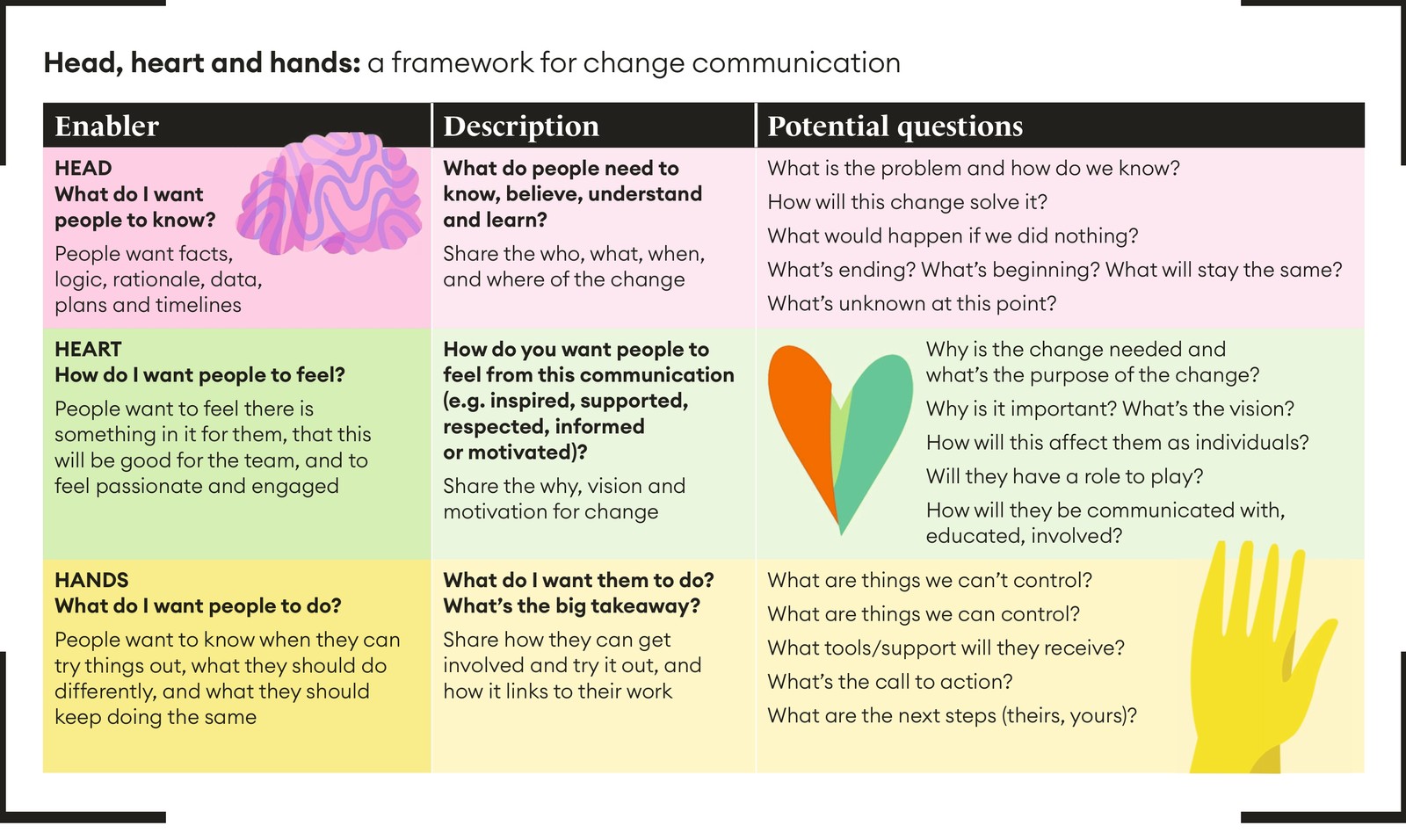
1. Engaging people’s head, heart and hands: communicate to build trust
When change requires people to adapt their skills, behaviors or attitudes, many respond at a deeply emotional level. Some employees have had negative experiences with change in the past. Some don’t understand how they will be impacted, or feel uncertain about the future. Others might mourn the perceived loss caused by the change. And some aren’t willing to expend the discretionary effort needed to make it succeed.
In truth, the hardest part of any change isn’t the outer event, but the inner adjustment required to accept it. The outer event might be a new manager, a different office or a revised company rule. The inside feeling is transition. It is the mental and emotional work you do to catch up with that new reality. While change happens in the environment, transition happens in the mind. Real adjustment only happens when people release old habits, old routines and their old self-image.
Some researchers have found that the failure to identify and be ready for the endings and losses that change produces is the largest problem that organizations in transition encounter. To engender trust in the transition process, leaders need to communicate to their employees’ heads, hearts and hands. By asking questions (table, opposite) leaders can identify what they want people to feel, what they need to know and what they can do to navigate the change.
One of my clients spent significant time describing a forthcoming change to his employees. He had PowerPoint slides with all the logic about the importance of the change, the expected return, and what was in it for the organization and employees to change. The content and style of delivery were pretty good. But when it came time for questions, an experienced manager in the back of the room raised his hand and said, “I get all of that… What do you want me to do?” The leader had described the big picture but hadn’t translated the change into their day-to-day work.
Communication needs to inspire trust by speaking to employees’ heads with facts and logic, bridging to their day-to-day work, and showing them how they can get involved. It needs to speak to their hearts – about what’s in it for them when they make the transition. You should not feel obligated to answer every potential question in every communication, however. Be selective and focused. For each communication, sit with the questions and determine what is needed across head, heart and hands. How do you want to describe the rationale at this stage of the change? How will you foster a conversation that motivates and inspires? And what do you want people to do differently as a result of the communication?
2. Create psychological safety: mine for dissent by asking questions
Several years ago, I worked with a global athletic footwear and apparel company that was navigating the transition back to the office that so many firms wrestled with post-pandemic. The leadership’s argument for returning to the office had a very good rationale and supportive data. But employees had equally convincing arguments about the benefits of remote work.
The solution wasn’t going to be found in the data or lived experience. It needed to be found through dialogue and understanding of each other’s positions. It became clear that both sides needed a chance to air concerns, to seek to understand each other, and to listen actively. Dealing with the disagreement head-on only seemed to create more resistance.
We created a tool to help leaders proactively mine for dissent; to uncover concerns in a psychologically safe way, through conversation (see left). The results were surprising. Where suspicion reigned, it was replaced with the beginnings of trust and respect. Where positions were entrenched, understanding of different perspectives started to blossom. Taskforces then worked together to find solutions and make joint decisions.
It would be time-consuming and tedious to ask all of the questions in one meeting. Instead, use one or two in different meetings to uncover resistance and dissenting views. Ensure that it is safe for people to share, challenge, contribute and learn. Resistance to change is not uncommon. What is uncommon is a leader who engages in the conversation and brings issues to light, rather than letting resistance and friction swirl around them.
A new level of capability
Changing the way you change requires a new level of leadership. Today’s challenges require leaders to lift their teams to operate at a level well above their current capacity and capability. It means cultivating trusting relationships and building environments where it is safe to learn and fail, to challenge and push back, and to contribute differently than in the past.
Engaging in dialogue and proactively uncovering resistance is a true leadership role. It’s hard to create a culture of psychological safety. But when done well, it is rewarded with lower costs of doing business, faster decision making, and engaged employees – a payoff well worth the effort.
Questions to mine for dissent
- What excites you about this change? What worries you?
- What do you think is most in need of improvement?
- What do you hope will/won’t happen in this change?
- What do you think will get in our way?
- Where do we have competing objectives?
- How might this affect other aspects of our business?
- What do you think would happen if we did nothing?
- What are things outside of our control? What are things we can control and influence?
- What are the rumors you have heard?
- What are people asking about? What questions do you have?
- What do you need to move forward in your change journey (e.g. facts, logic, details, plans, impact on me and my team)?
- How would you like to be involved?
R Kendall Lyman is a consultant, executive coach and author of Change the Way You Change: 5 Roles of Leaders Who Accelerate Business Performance (Greenleaf Book Group Press)
Image Laura Díez/Unsplash
Writing: R Kendall Lyman
