

Most culture change programs don’t work. Here’s an ecosystem approach that does
Writing: John Childress

Picture this: a Ferrari sits in your driveway – gleaming red, powerful engine, pristine leather interior. You slide into the driver’s seat, turn the key, and… nothing. The problem? An empty tank.
This is precisely how most organizations approach performance improvement. They’ve invested millions in the vehicle – their strategic plan, technology and marketing campaigns – but they’ve neglected the fuel. That fuel is corporate culture. You might have the most brilliant strategy in the world, but without the right culture to enable it, at best you’re limping along.
Culture is not an initiative. It’s the foundation that enables all your business initiatives.
The power of culture
Over the past 20 years, major studies by McKinsey, PwC, Harvard and others have established an irrefutable connection between culture and business performance. Companies with strong, aligned, fit-for-purpose cultures outperform their competitors across nearly every metric: from revenue growth to employee retention, to innovation and customer service.
Yet culture still features more in slogans than in strategic initiatives. In one survey of 1,348 corporate executives, an impressive 92% believed that improving their firm’s culture would increase the value and performance of their company. But only 16% believed that their own firm’s culture is where it needs to be for future success. What is driving this massive gap?
What creates a culture ecosystem
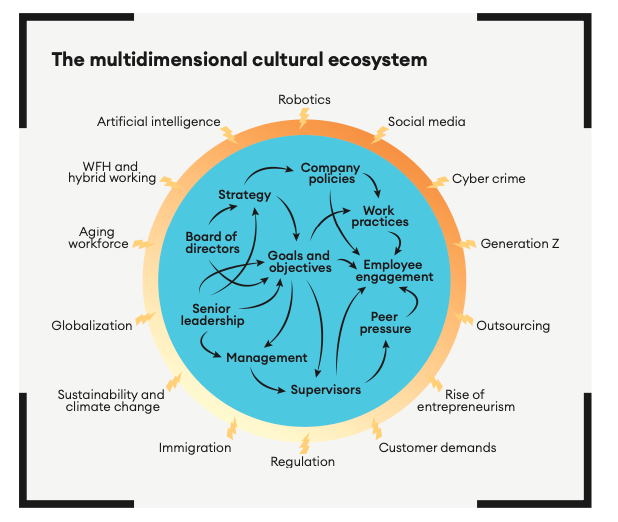
Ask most executives what shapes their organization’s culture, and you’ll hear familiar answers: attitudes, behaviors, management actions. These elements matter of course. But they’re not the root cause. So what really creates and sustains culture? It’s the organizational ecosystem: an interconnected network of policies, work processes, business systems and leadership, plus multiple external pressures, that influence how people think, behave and perform – positively or negatively.
Consider the culture in investment banking. After the 2008 financial crisis, nearly every major bank proclaimed new values emphasizing integrity, risk management and customer focus. Many sent their executives to ethics training. Yet scandals continued. TD Bank agreed to a $3 billion fine for failing to monitor money laundering. BNP Paribas paid $8.9 billion for sanctions violations. Many major banks have racked up fines for fraud.
The hidden causal factor? Not a few bad apples, but compensation policies that reward secretive and excessive risk-taking. The organizational ecosystem inadvertently incentivizes the very behaviors that the stated values were meant to prevent.
You can’t change culture with training and new proclamations. You have to change the ecosystem of causal factors – and many of these are not well understood.
Why the ecosystem matters
Don’t say, “Our people are disengaged.” Tell the truth: “We’ve got an ecosystem that creates disengaged people.” Your corporate culture is the product of an interconnected ecosystem. When executives return from a leadership program fired up to transform their department, they walk back into the same meeting structures, performance metrics, approval processes, HR policies and resource allocation systems that created the culture in the first place. The established ecosystem of causal factors hasn’t changed.
This explains why culture change efforts that focus solely on behaviors consistently fail: they’re treating symptoms, not causes. In my book, Culture 4.0: The Future of Corporate Culture, I map out a new framework for understanding and shaping organizational culture – one grounded in ecosystem analysis.
The 4.0 designation reflects the evolution of how we understand culture.
Culture 1.0 – 1950–1980 The emergence of corporate culture focusing on vision, values and mission statements
Culture 2.0 – 1980–2000 Linking culture to business performance
Culture 3.0 – 2000–2020 Using data to measure culture
Culture 4.0 – 2020 onwards A multidimensional ecosystem view, recognizing that corporate cultures are shaped by both external and internal forces
Culture 4.0 identifies multiple external factors reshaping the business landscape, and the ways that they impact both corporate culture and business performance.
These include the shift to hybrid and remote work; artificial intelligence and automation; rising cybersecurity threats; generational shifts as Gen Z enters the workforce; an aging workforce delaying retirement; the climate crisis and demands for sustainability; evolving customer expectations; changing gender dynamics; toxic workplace behaviors and psychological safety concerns; immigration and global talent mobility; and the rise of the gig economy and outsourcing.
These and other powerful external forces influence employee attitudes, behaviors and actions – and, ultimately, business performance. Leaders who ignore these cultural causal factors are, in effect, trying to garden without acknowledging the weather.
There are also multiple hidden internal causal factors. To identify them, leaders must examine their organization honestly.
Policies, budgeting and procedures What do your approval processes, decision rights and operating guidelines incentivize? Do they reward collaboration or silos? Speed or caution? Accountability or presenteeism? Innovation or compliance?
Resource allocation Where does the money go? Which projects get funded? Which teams grow? Your budget is a truth-teller: it reveals what your organization truly values
Meeting dynamics How are decisions made? Are people afraid to speak up? Who gets heard? These patterns reinforce your culture
Career advancement Who gets promoted, and why? Do people rise through results and values, or politics? Promotion decisions send powerful signals about what matters
Reshaping the culture ecosystem
To reshape your organization’s culture ecosystem requires action in nine key areas: change the system, change the culture.
1. Design culture to support the strategy
Too often, culture and strategy are viewed as two separate issues, with culture seen as an HR matter and strategy as a leadership and board concern. In reality, they are two sides of the same coin; they cannot be separated. As culture transformation expert and veteran chief human resources officer Elaine Page says, “Culture is how strategy breathes.”
When a culture document does not align with strategy and enable its execution, it becomes useless, or even a barrier to business success. Senior leaders must identify the key cultural elements and behaviors necessary to execute their business strategy effectively. These form the backbone of an effective and aligned corporate culture.
2. Identify the causal factors
Begin with an honest appraisal of your current culture. Senior leaders and the board must begin this journey using multiple data sources. Identify the policies, processes and systems that most directly influence attitudes and work behaviors. Don’t rely on org charts or policy manuals – observe what actually happens. Gather employee feedback, customer feedback and leadership assessments, including 360-degree feedback. Secure candid input from suppliers and former employees. Use best-practice research to determine and quantify each causal factor’s relative impact. For example, does your incentive compensation system drive collaboration and innovation, or silo thinking and excessive risk? Are managers and supervisors trained to spot and deal with peer pressure that negatively impacts productivity?
3. Map the causal factor interconnections
Using structured and unstructured data measured against best practices, use ecosystem mapping software to build a visual map of your culture ecosystem. Which organizational elements are primary causal factors, and which are enablers of others? This reveals how cultural elements interact and where leverage points exist.
By using a color-coded system based on internal data, you will be able to easily spot those causal factors that pose the biggest risks to the culture ecosystem.
4. Identify elements that are out of alignment
Which causal factors conflict with your business and cultural objectives and drive unintended negative outcomes? Which currently incentivize behaviors you don’t want? Legacy hiring, performance management policies, rewards and governance structures often drive unintended behaviors. These must be reviewed and reshaped so that your systems reinforce, rather than undermine, the fit-for-purpose culture you are building.
5. Engage all employees
Employee understanding and active involvement are essential for sustainable cultural change. It is critical at this stage to bring employees together in teams tasked with identifying policies and work processes that are not aligned, and with helping to describe the culture in terms that everyone – from the night shift to the boardroom – can understand. This includes implementing culture champion networks across all levels as culture sounding boards and support. Southwest Airlines’ Culture Committee, comprising employees from throughout the organization, plays a central role in sustaining its distinctive culture through various activities, recognition initiatives and storytelling efforts.
6. Target high-leverage changes
Not all causal factors are equally influential. Focus on the handful of policies or processes that, if changed, would create a fit-for-purpose culture. As you redesign these, assign clear ownership by appointing an informed ‘captain’ responsible for each significant causal factor improvement. Give them the accountability to cross functional boundaries to review and recommend improvements. Spotify’s reorganization into squads, tribes, chapters and guilds exemplifies a deliberate structural realignment aimed at preserving the nimble, entrepreneurial spirit of a startup while scaling as a rapidly growing organization.
7. Monitor external forces
Cultural alignment with strategy and external realities is never complete. Track how major technological, social and economic shifts are impacting your culture and business performance. Build regular review forums where teams gather customer and partner perspectives; benchmark against industry trends; and experiment with new practices to keep your culture adaptive and resilient.
8. Measure, measure, measure
Effective measurement includes tracking leading indicators of cultural health before they impact business results, conducting regular pulse surveys to monitor causal factor changes across the organization, connecting cultural outcomes to strategic objectives with clear metrics, and implementing leadership accountability for cultural progress as part of performance evaluations. Adobe’s regular ‘check-in’ system replaced traditional performance reviews with ongoing conversations about expectations, feedback and growth – a systemic change designed to reinforce its culture of continuous improvement.
9. Build for adaptation
Cultural alignment with company strategy and external business realities is never complete. Leadership must build mechanisms for ongoing adaptation, including regular culture update conferences. At these meetings, teams from across the organization reflect on current cultural strengths and challenges, discuss external perspectives, review industry benchmarking and trend analysis to identify emerging cultural shifts, and experiment with new cultural practices that might better serve future conditions. Mars Inc developed ‘Associates in Conversation,’ a program that brings together employees across levels to discuss cultural strengths and opportunities.
Fueling success
Building a fit-for-purpose corporate culture means reshaping the organizational ecosystem. Without making changes to the underlying causal factors, sustainable culture change is impossible. The good news? Once you understand culture as an ecosystem, you gain powerful leverage points for change. Instead of trying to change the behavior of 10,000 employees, redesign a handful of key causal factors and let the ecosystem do the work.
The question isn’t whether culture matters. It does: it’s the fuel that drives your business forward. The question is whether you’re willing to change the organizational systems that create it.
John R Childress advises CEOs and leadership teams on culture, and is author of Culture 4.0: The future of corporate culture (LID Publishing)
