
AI doesn’t replace human judgment. It amplifies it
Writing: Suzanne de Janasz & Yadvinder Rana

Negotiation has always been a deeply human discipline. It relies on judgment, empathy, creativity and the ability to see possibility where others see constraint. Yet the negotiation landscape is shifting. Artificial intelligence is no longer a peripheral tool; it is becoming a core capability for leaders who want to create higher joint value, uncover overlooked opportunities and make better decisions under pressure.
While many think engaging AI can help after they’ve decided to negotiate, this ignores the biggest barrier to effectiveness: awareness of overlooked opportunities. We can’t improve our preparation, strategy or tactics on negotiations we’ve never even recognized. AI changes the calculus by expanding what leaders see and choose to act on, long before the first conversation begins. These are the earliest ‘steps’ noted in previous research. (See ‘We Often Overlook Opportunities to Negotiate’, Suzanne de Janasz, Harvard Business Review, 2021.)
AI can help leaders not only identify hidden opportunities, but also clarify interests, structure more creative deals and learn from their interactions – amplifying but not replacing human judgment.
Why AI matters now
Three forces make AI indispensable for leaders in negotiations.
1. The information landscape has exploded
Executives must synthesize industry data, company financials, stakeholder incentives, cultural norms and competitive benchmarks. AI can process this complexity in seconds, surfacing insights that would take humans hours or days to uncover.
2. Negotiations increasingly span cultures, geographies and modalities
Hybrid work and global collaboration mean negotiators must adapt to diverse communication styles and expectations. AI can analyze patterns, anticipate friction points, and help leaders tailor their approach.
3. The cost of missed opportunities is rising
In a world of talent shortages, rapid innovation cycles and shifting employee expectations, failing to negotiate – for resources, flexibility, compensation or collaboration – has real financial and relational consequences.
AI helps leaders see opportunities others miss and leverage information others don’t have.
Where AI has the greatest impact
A negotiation is not a single moment. It is a sequence of cognitive and relational decisions across five distinct phases: Recognize, Evaluate, Prepare, Engage and Reflect. AI strengthens each phase in distinct ways, helping negotiators work through company information, compare possible agreements and rehearse difficult conversations. It can also help them recognize opportunities and involve colleagues before a negotiation becomes urgent. AI’s value hinges on the quality of prompts and the negotiator’s discernment of the answers.
Recognize: “Is this a negotiation moment?”
This is where AI’s impact is most transformative. Leaders often overlook opportunities because they feel uneasy, assume norms are fixed, or underestimate their leverage. AI can analyze situations, flag misalignments and surface reasonable asks – helping negotiators identify moments they would otherwise accept by default. You don’t get what you don’t ask for.
The second kind of opportunity lies inside your company. You suspect a negotiation is coming but cannot handle it alone; the people you need are not involved yet.
When a salesperson or buyer is asked what they do most of the time, they respond that they’re negotiating with their own colleagues. A seller goes to a first meeting with a client and cannot answer half the questions because the answers lie in different departments (e.g. legal, engineering, finance) and none of them works for her. A buyer gets the supplier and deadline from an internal client who has already made their choice. Both go into the ensuing negotiation handicapped, bound by the deadline. In our experience, this is where many deals are lost – before anybody starts preparing.
These are the kinds of questions we advise negotiators to ask their AI.
“Analyze this situation [enter synopsis of conflict or misalignment here]. What hidden negotiation opportunity might I be overlooking?”
“If a more confident version of me were evaluating this situation, what would I notice or question?”
“Given this scenario, what are three things I might reasonably ask for that I haven’t considered?”
The impact of AI in this stage depends on the disciplined use of a repeatable set of questions when a potential opportunity emerges, as well as the ability to assess and integrate stakeholders’ needs and colleagues’ assistance in the time available.
Evaluate: “Is it worth the effort?”
AI helps leaders assess the potential gains – financial, emotional, moral, psychological – of negotiating, as well as the costs of staying silent.
AI can model relational impacts, identify leverage and highlight long-term consequences, enabling leaders to make more deliberate and high-value choices. Consider these prompts.
“If I choose not to negotiate, what might I lose or leave on the table?”
“Analyze how negotiating (or not negotiating) might affect my relationship with this person or group.”
Prepare: “What information can I leverage?”
Many people recognize the importance of planning and preparation – in theory, at least. In previous research by de Janasz, we asked leaders about the reality of preparation. A majority of respondents agreed with the statement: “When others engage me in a negotiation or conflict, I respond, even if I haven’t had a chance to prepare.”
For some, being willing to respond at any moment is a point of pride. Yet it risks a lack of intellectual and emotional readiness. If you’re caught off-guard by an urgent request – “We need to discuss this issue” – the best response is, “Agreed; how does Wednesday at 1pm work?”
Preparation is critical to negotiations. This is where AI can help clarify goals and interests, analyze the other party’s likely motivations, gather industry and stakeholder data, identify deal structures and generate persuasive arguments. Using separate prompts that address each of these elements, perhaps iteratively, can uncover critical information. Include historical negotiations and outcomes with the other party if relevant.
“In the past few negotiations with [company/ organization], we leveraged [relationships, data, trends] and secured a good agreement [specify outcome]. Offer several ideas for how the current external environment and internal constraints [specify here] impact our current goal of achieving [specify].”
Another option is to use an all-encompassing prompt.
“Help me prepare for an upcoming negotiation. Clarify my goals and Batna [best alternative if no agreement is reached]; identify the other party’s interests and constraints; gather relevant industry and stakeholder data, identify favorable deal structures, and generate several persuasive arguments to make in presenting my ask.”
When both sides use AI, each can explore trade-offs and build packages independently before exchanging information. Rana’s 2024 working paper proposes “technological equilibrium,” where equal AI access supports joint gains and a fairer process without requiring the parties to build trust.
By stating your assumptions in your package-building prompt, you’ll be able to test them and be ready to adapt to other AI-generated packages at the negotiating table. Of course, whether you choose to share packages before or during the negotiation depends on the relationship with your negotiating partner.
Many skip the second half of preparation: rehearsal. An AI agent that helped you prepare can hand over to a second agent that plays the other party in your negotiation: the buyer, the seller or the person you are worried about. You can role-play with the AI, negotiating with it before your real meeting; or practice with a colleague on a video call, and ask AI to assess the transcript. Either way, the feedback helps you adjust your approach. Rehearsal also reduces one’s fear of negotiating: it gets the ‘first time’ out of the way.
AI therefore speeds up and improves negotiation preparation. It also forces a discipline few of us exercise regularly: preparing the same key questions, considering and writing down the options, and evaluating the other side’s assumptions, position or goals.
But do not blindly print and use AI responses without critical thinking, judgment and iteration. If your direction is wrong, AI is the GPS that gets you there faster.
Engage: “How do I show up in the conversation?”
Negotiations almost never happen in one round. There is a first meeting, then a week in which somebody talks to a boss or a lawyer, then a second meeting. Between rounds is where you update the strategy. This is the phase where AI is most useful, so discuss the situation with it.
“Here is what happened, here is what they said; which of our scenarios are we in, and what do we bring next week?”
AI can be more useful in the room than most realize, too. You can feed a live transcript to the agent that prepared with you. The agent stays silent unless something is wrong. Then it sends a message to your phone: “We are not in scenario one; we are in scenario three.” Your colleague taps your knee and says, “Let’s step outside for a few minutes.”
You should always be open about any plans to have an AI agent following the conversation and get prior agreement, so as not to jeopardize trust. But it is especially helpful if you are solo and your counterparts are a team: your agent becomes your colleague. It can help refine messaging, anticipate pushback and rehearse responses.
Create space to use AI to process new information by using phrases such as these with your counterparts. “Information that is new to us was just presented. We’ll need a short break to process this,” or, “You’ve asked a question that requires consultation with the CFO; we can break, and I can reach out.”
Reflect: “What did I learn?”
After the negotiation, AI can analyze transcripts or recordings or self-generated summaries (recognizing the bias) to identify patterns, highlight strengths and surface opportunities for improvement.
“Help me debrief this negotiation. Analyze my clarity, emotional management, communication, leverage, decision-making and the quality of the outcome.”
“What one or two behaviors or preparation steps would have made the biggest difference?”
The discipline of honestly assessing and reflecting on a negotiation matters enormously. An agent can make it far more valuable.
Data security
When it comes to using AI in negotiations, every company we talk to asks: “Where does the data go, who can see it and what happens if we stop?” Security is the top concern – and the number one excuse, because it is the easiest reason not to start.
A multinational in the food industry contacted one of us about supporting its procurement team. Five months of meetings followed; almost none of them focused on what the AI agents could do. Instead, they focused on where the negotiation files would sit, who would own the agent’s design if the company didn’t go ahead, and who would be present. A pilot eventually got underway, managed under a comprehensive confidentiality agreement. What took time was overcoming resistance to change, not discussions about the technology.
Before using AI with company information, agree on the choice, storage, access and final disposition of documents. Decide the platform and access against those requirements.
The human element still matters
AI makes bad negotiators faster and smart negotiators better. It expands awareness, sharpens judgment and accelerates preparation – but it does not replace emotional intelligence, creativity or trust. It is just a tool. The outcome and success of negotiations depend on the skills, judgment and expertise of the individuals involved.
The relationship between negotiating skills and the ability to use AI can be plotted in a classic grid, as in Figure 1 (opposite). The traditional expert falls in the upper-left quadrant; they are very skilled and work at half capacity. The superficial technologist is found in the lower-right quadrant. This is the most dangerous place to be, because AI sounds just as confident when it’s right as when it’s wrong.
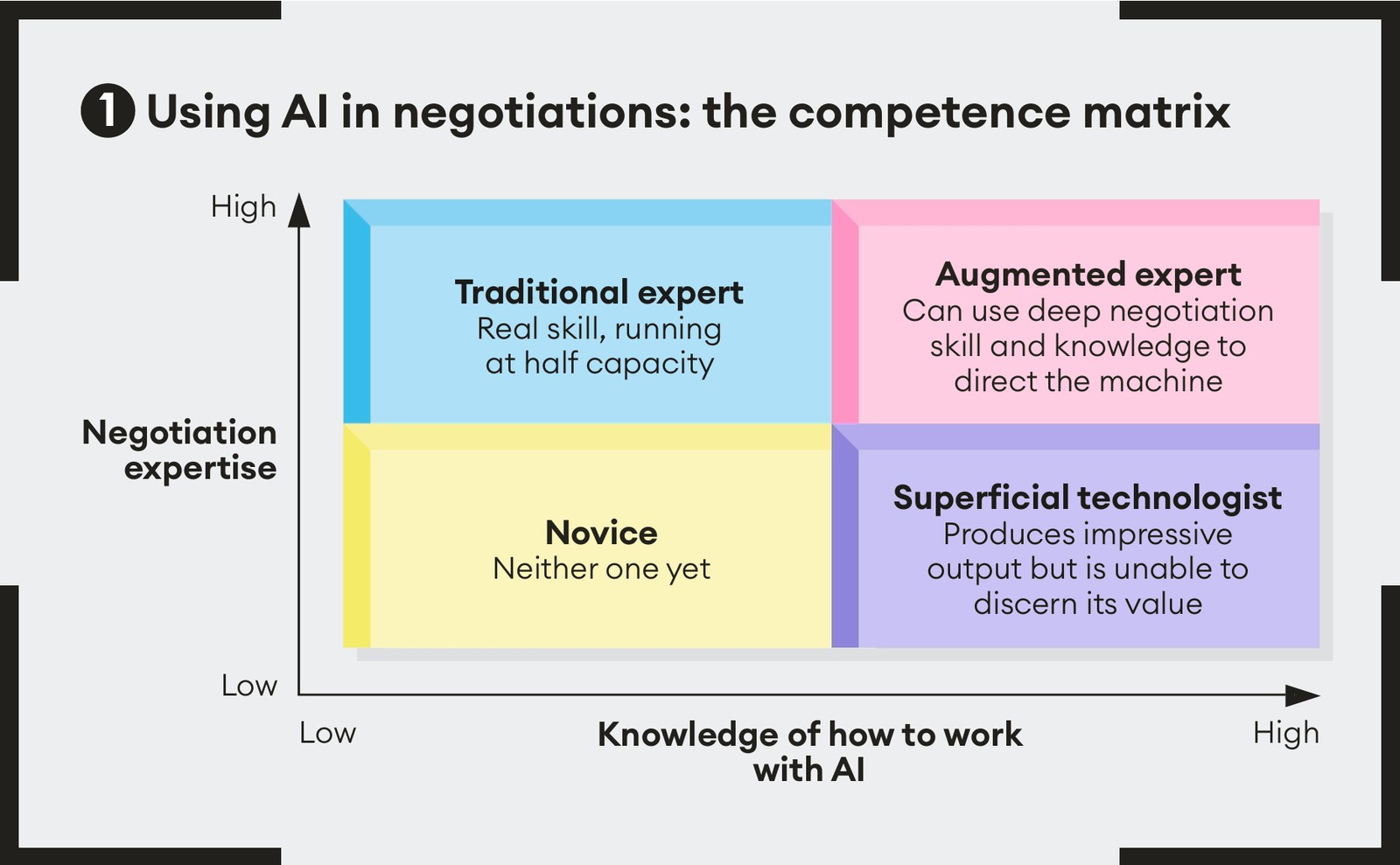
The quadrant to strive for is the upper-right. It represents leaders who will thrive in the next decade. By combining human insight and emotional intelligence with AI-enabled clarity, they will create value far beyond what anyone could imagine.
How AI changes real negotiations
AI expands the negotiator’s field of vision, revealing options, risks and opportunities that would otherwise remain hidden. Consider three common scenarios.
Compensation negotiations AI benchmarks compensation, identifies non-monetary levers and helps leaders rehearse responses to likely objections. The result is higher total value and stronger alignment with long-term goals.
Cross-cultural partnerships AI analyzes communication norms and decision-making styles across regions, reducing misunderstandings and accelerating trust-building.
Internal resource negotiations AI helps leaders articulate the downstream impact of receiving additional headcount or budget, producing clearer justification and more compelling cases.
Suzanne de Janasz is a professor, speaker, author and executive educator specializing in negotiation, leadership and gender. Yadvinder Rana is a professor, practitioner and researcher on AI negotiation systems
Images: Shutterstock; Rizki Ardia/Unsplash
