
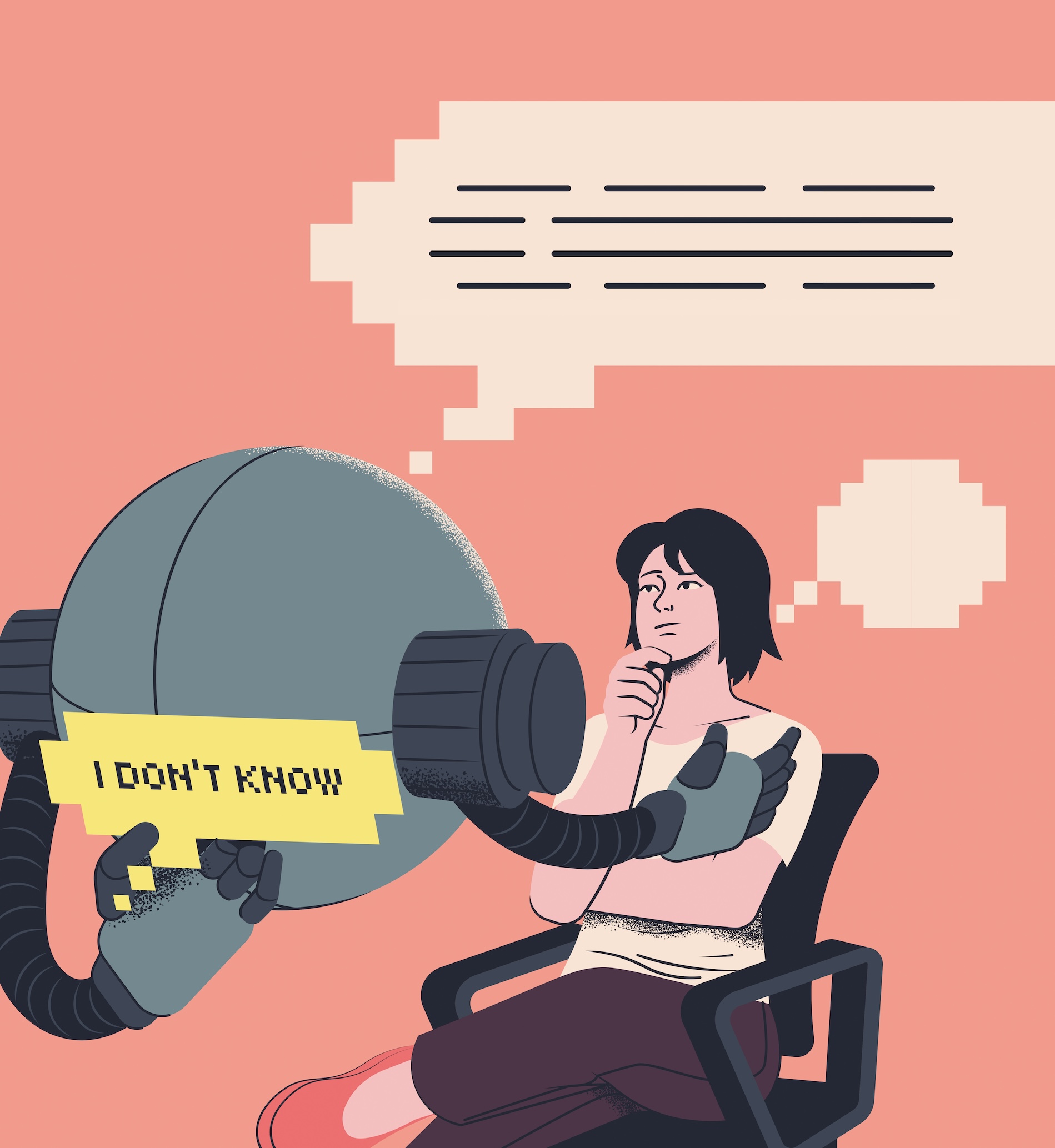
AI excels at complicated decisions but complex ones demand human judgment
Writing Roger Spitz

The future of decision-making is inseparable from the future of predictability – yet most organizations deploy AI to make significant decisions without asking a critical prior question. How predictable is the environment in which these decisions are made?
That omission is the costliest mistake in enterprise AI. Most failures are not technical or deployment challenges, but category errors: AI is delegated decisions that it is poorly suited to make and left underused where it genuinely excels. Better models will not fix a category error, because more data or greater efficiency does not translate into effectiveness. Closing the gap between potential and practice starts with decoding the environment – the nature of complexity, the limits of data, and AI’s ascent of the decision-making value chain.
Complex is beyond complicated
Complicated environments are ordered and generally linear. There is a range of right answers, the unknowns are identifiable, and cause and effect can be analyzed to assess the best response in advance. Designing an aircraft engine or sending a probe to Mars is complicated; so are logistics optimization, fraud detection and protein folding. These domains yield to pattern recognition at scale, given well-defined outcomes – precisely where AI’s strength lies. Google DeepMind’s AlphaFold has generated structure predictions for over 200 million proteins, all but solving a problem that had defeated biologists for decades – work recognized by the 2024 Nobel Prize in Chemistry. In 2025, an MIT team used generative AI to design novel molecules and identified promising antibiotic candidates against drug-resistant pathogens, including gonorrhea and MRSA.
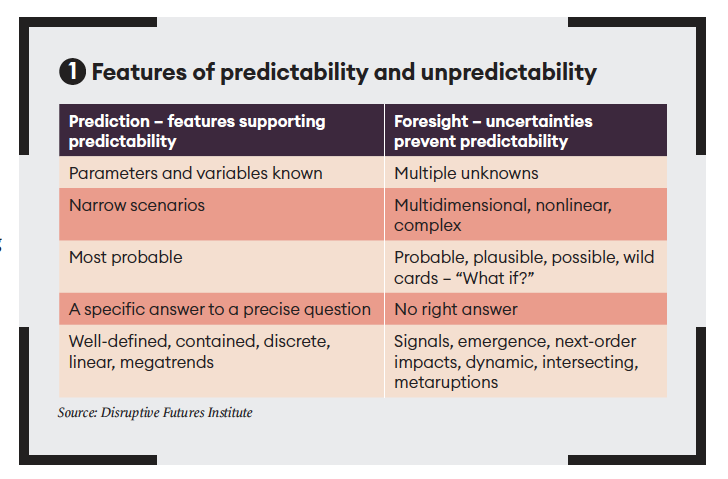
Complex environments are another matter. They are nonlinear, dynamic and interconnected, with emergent properties and unknown unknowns. There may be no right answer; relationships are unpredictable, the parts interdependent, and causality is visible only in retrospect. The Amazon, geopolitics and financial markets are under deep uncertainty: all are complex in their own right, let alone as they interact. Neither humans nor AI are adept here. The danger comes when leaders apply complicated-domain answers to complex-domain questions, where automation mistakes confidence for capability and hides asymmetric risk behind false predictability.
Complicated domains favor innovation; complex ones demand invention. And while AI accelerates innovation, invention remains stubbornly human.
There is no data on the future
Consider macro forecasting. Despite unprecedented volumes of data, economists and policymakers failed to anticipate the sustained inflation – the highest in decades – that hit the US in the wake of the pandemic and the invasion of Ukraine. Treasury Secretary Janet Yellen had called the risk small, but conceded in 2022 that “I was wrong,” blaming “unanticipated and large shocks.” The models assumed a controllable trajectory; the world declined to cooperate.
The lesson is not to abandon data, but to recognize what it is. All data is historical; the purpose of every decision lies in the future. Yet there is no data on the future. As uncertainty deepens, predictability declines and the cost of wrongly delegating decisions increases. Leaders need foresight, not just forecasting – and knowing which mode they are in is a crucial skill.
Consider 2026 alone. US and Israeli strikes on Iran’s nuclear facilities in late February triggered the closure of the Strait of Hormuz, sending energy markets into crisis and dramatically slowing projected global trade. Geopolitics simultaneously weaponized cyberspace, with AI-enabled threats and supply chain vulnerabilities compounding what the energy shock had already set in motion. Each amplified the other, cascading uncertainty across domains. In June, the new Federal Reserve chairman Kevin Warsh dropped the Fed’s forward guidance and declined to submit his own interest-rate projection alongside other Fed officials – the world’s most influential forecaster, amid deep uncertainty, declining to forecast its next move.
Machines are moving up the decision-making value chain
The decision-making value chain spans descriptive analytics, which tell you what happened; predictive analytics, which estimate what comes next; and prescriptive systems that recommend what to do (and may automate execution). The further up the chain AI climbs, the more the nature of the environment determines whether delegation is an asset or an abdication.
Machines have long surpassed human capacity for pattern recognition across unstructured data at scale, and the higher rungs are following fast, with AI now taking decisions once thought too important to entrust to machines. Viz.ai’s stroke-detection software alerts care teams faster than standard hospital workflows, saving brain function by the minute. Procurement systems approve and place orders autonomously. AI executes millions of financial trades daily – decisions once requiring a trader’s judgment now made by machines in milliseconds.
The decisive move is the last one, and AI is increasingly not only recommending options but selecting and executing them. A 2026 Rand study, A Formal Model of How Artificial Intelligence Erodes Human Agency, draws that distinction. Every decision has two parts – structuring it (defining the problem to be solved and the available options) and choosing among them. Structuring is where power quietly sits: an AI that shapes which options reach the table determines the outcome before any choice is consciously made. AI may also take over the choice, removing the human even when the framing was theirs. Either path narrows agency – yet neither looks dramatic on any single decision.
Where does automation arrive next? Anywhere where outcomes are well-defined, the pattern repeats, and the answer can be checked cost-effectively and reliably. Legal document review and claims processing fit the bill. Other areas will remain resistant. When deciding whether to enter a new market, how to address emerging climate challenges or how to reinvent the business in the face of discontinuity, there is no training data – and no scalable check can validate a strategic judgment before reality renders its own verdict.
There is a quieter reason leaders hand complex decisions to algorithms, unrelated to capability. If a leader gets a big call wrong, it is a career problem; if an algorithm gets it wrong, it is a vendor problem. Delegating outsources accountability – which is why crossing from potential to practice is as much a matter of organizational courage and culture as of technology. Humans have skin in the game; machines have only algorithms in the game.
Techistentialism: the quiet erosion of agency
In 2017, we named our foresight practice Techistential because humanity’s technological and existential conditions can no longer be separated. As AI climbs the value chain, the question is not how much machines will augment human decision-making, but whether humans choose to remain involved at all.
The exponential cost of automating agency is where the real existential risk lies – more practical, and less cinematic than the science fiction versions. When organizations habitually delegate complex decisions to algorithms, decision muscle atrophies and reliance slips into dependence. Brian Patrick Green at Santa Clara’s Markkula Center for Applied Ethics calls it “moral deskilling.”
The risk may not be machines taking over or reaching human-level intelligence, but the opposite: people starting to think and respond like idle machines, unable to connect the emerging dots of a complex, systemic world. We call this ‘superstupidity,’ and it can counter any level of intelligence. AI does not have to reach artificial general intelligence to shift the balance – it simply needs to become better than us at tasks we stop practicing. Agency does not vanish in a single decision; it erodes quietly until the capacity for sense-making and judgment in complex environments is gone.
This is the existential risk – not the machine that turns hostile, but the organization that optimizes its way into a position where it no longer has the capacity to overrule the machine. Leaders who cannot tell the predictable from the unpredictable will keep funding expensive AI theater – and quietly surrendering the one critical capability that cannot be outsourced.
Defying the odds
What, then, remains distinctly human? The case for keeping humans accountable in complexity is not that they predict better – they do not, and neither do machines. It is that only humans can redefine the problem, invent options with no precedent, and own a choice whose outcome cannot be known in advance. Facing George Foreman in 1974, Muhammad Ali won with a strategy that had no precedent. Rope-a-dope was not an optimization; it was an invention. The unprecedented never comes with plentiful or relevant data – which is exactly why the most consequential decisions in complex environments cannot be delegated.
Leaders need to decode significant decisions before tooling them. First, ask three questions. Are the parameters known? Is there a verifiable right answer? Can causality be assessed before acting, or only in retrospect? Two or three “no” answers put you in complexity, where AI augments judgment rather than replacing it.
Most real initiatives are hybrids. A market-entry decision has complicated parts – tax structures, supply chain economics, demand modeling – that AI crunches better than any team. It also has complex parts – how a regulatory regime might evolve, how geopolitical shifts are reordering the competitive landscape, how consumer trust may form or fracture – where there is no training data and no right answer.
Automate the first; keep a human accountable for the second. A model may recommend doubling down on a market that a seasoned team already senses is turning, because it has never seen a regime shift – and, until the shift lands, the data will point the other way.
Next: draw on the AAA Framework to become antifragile, anticipatory and agile.
Build antifragile foundations Leaders’ instinctive question – “What can we automate?” – may be the wrong one. Optimized systems eliminate inefficiencies and, with them, the buffers needed to absorb shocks. One defective CrowdStrike update grounded airlines, hospitals and banks worldwide in 2024 – no malice or AI involvement required.
The trade-off between efficiency and resilience is ultimately a choice between fragility and antifragility. Coined by Nassim Nicholas Taleb, antifragility goes beyond resilience, describing systems that improve in response to stressors and volatility. Build it by auditing where efficiency has stripped out buffers like redundancy, liquidity and modularity – traits that look wasteful in stable conditions, but which prove decisive when volatility arrives. Focus on the amplitude of outcomes, not only their probability: the same uncertainty that makes catastrophic loss possible makes asymmetric gain available too.
Antifragile foundations mean accepting randomness, watching for the non-obvious, acknowledging that the rare is becoming less rare, and positioning the organization to benefit when others break.
Exercise the anticipatory decision muscle Anticipatory capacity is built, not bought, and it atrophies fastest where automation runs deepest. Make pre-mortems routine: before a major commitment, have the team imagine it is 18 months on and the decision has failed badly, then write down why. Stated as fact rather than risk, the exercise surfaces the objections nobody wanted to raise. Pair this with scenarios that rehearse decisions for which no historical data exists, so judgment under deep uncertainty is practiced before the crisis or missed opportunity, not improvised in it. Ask “What if this expands larger than expected?” and “What else might this impact?”
Develop cognitive, emergent and strategic agility Decide in the here and now without losing the longer-term vision – adapting continuously as feedback emerges. Agility requires an experimental mindset: curiosity over certainty, diverse perspectives over consensus, and enough tolerance for failure to let instructive patterns emerge.
Agency is the difference
No matter how capable our machines become, the AAA approach works only when activated by agency: informed choices, aligned with values and environment. Agency is like an unexercised option: without action, it holds no value.
Roger Spitz is president of Techistential, author of Disrupt With Impact (Kogan Page), and a Duke CE educator
