

Leaders who create movement without formal authority are the antidote to rigid command-and-control practices that slow organizations down
Writing: Justin Pennington

An invisible battle is raging inside today’s organizations. On the one hand, there is the drive for innovation to meet rising customer expectations, technological change and a changing regulatory environment. On the other hand, there are cultural systems maintaining the status quo.
This lived reality plays out in a series of contradictions. We expect teamwork across functions and geographies, yet we make decisions hierarchically. We expect talent to come up with innovative solutions, yet we want to avoid risk. We encourage people to speak up with their ideas, yet we tacitly reward conformity because it’s safe. It seems leadership hasn’t caught up with the way we work.
Many organizational teams still operate through a dominant leadership approach designed for a different era. The consequences are slow decision-making, overworked managers, disengaged employees and an inability to generate new ideas, let alone convert them into reality.
Work no longer follows the organization chart
The legacy leadership model shaped management practice. Hierarchy became the organizing principle: managers managed, specialists specialized, knowledge flowed upwards, and decisions flowed down from the top. Leaders were rewarded for confidence and certainty.
This approach once created clarity. Now it creates the very dynamics it’s trying to prevent: risk and delay.
Today, much work crosses departmental silos. Projects bring together analysts, technical specialists and operational managers, many of whom contribute to several teams or organizations at once.
Problem complexity has changed too. In more siloed environments, problems were there to be solved: to remove a known fault and restore normal operating function. Today’s complex problems are far more disruptive and transitional. They often have no clear answer because of their interdependent nature. Everything is cause and effect, and the goal is not elimination, but stability. Today’s issues are no longer solved but resolved.
The adoption gap
When control becomes entrenched, an organization can appear to function effectively when it is actually being stifled. Unfortunately, control is often the default tactic for organizations dealing with complexity and uncertainty. Senior leaders are expected to have all the answers, even though they are operating in markets and with new technologies they have little or no experience of. They are expected to make decisions that no single individual could make in the time available, because most of their time is spent in meetings.
The modern organization often operates as little more than a series of decisions. The gap between knowing what to do and putting it into practice becomes visible every day. It’s become the real test for any leadership team on a Monday morning. How do you handle a change in deadline? A difficult customer? A problem with the budget?
These are the moments when organizations reveal their true nature and revert to old ways of working. Decisions are taken by senior management. Information is hoarded by individuals. Control is increased. But the more leaders centralize control to reduce risk, the more dependence and delay they create, which in turn produces further pressure to take control. It becomes a self-reinforcing cycle (Figure 1).
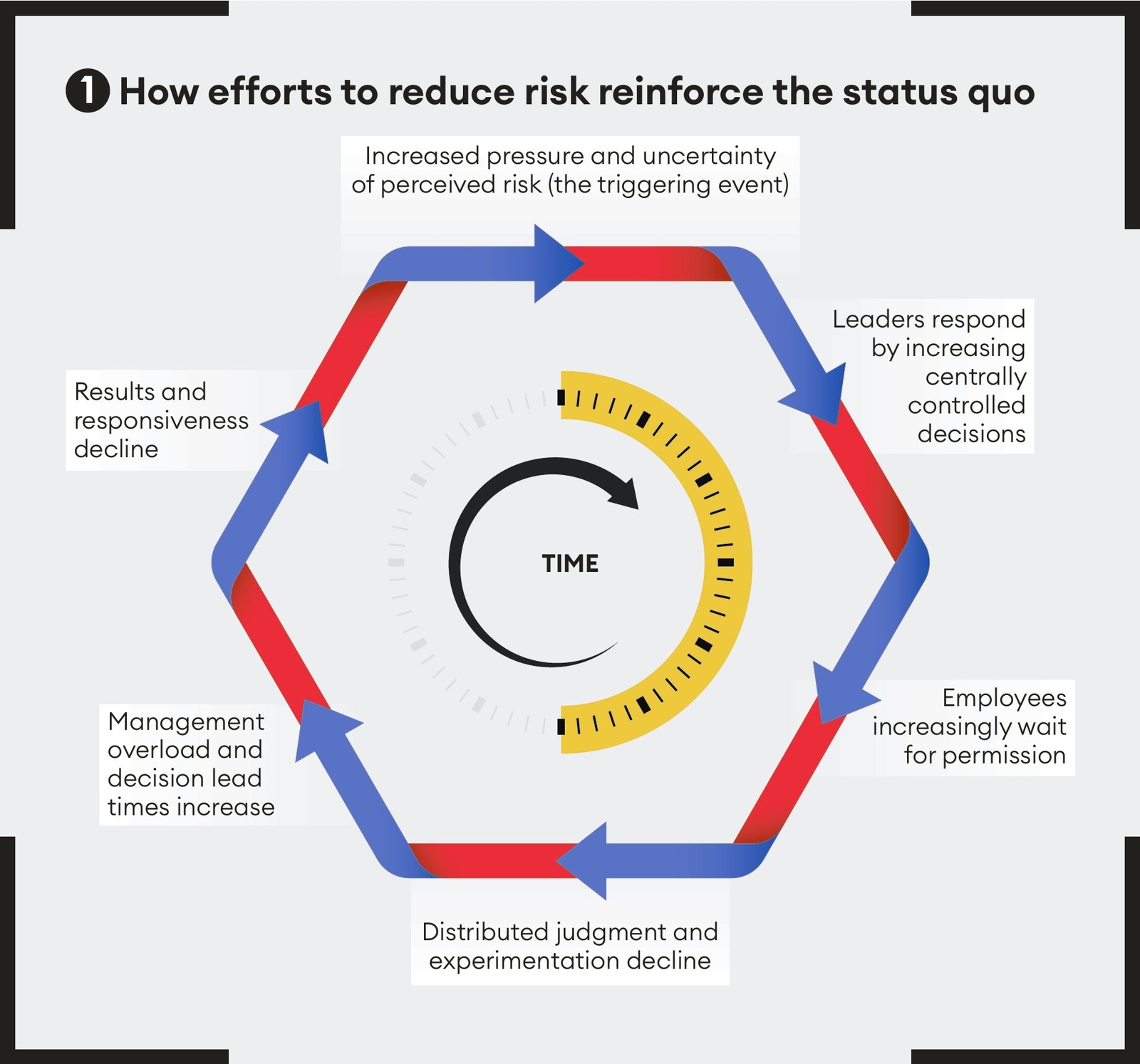
This recurring cycle shows there is often incompatibility between an organization’s language and its operating systems. New ways of operating that encourage agility, empowerment and collaboration exist alongside incentives that promote control, escalate failure and provide certainty. Employees quickly read those signals and respond accordingly. Difficult decisions are escalated upward. Experimentation – which carries risk – is subtly reduced. Conversations that might challenge outdated assumptions are avoided.
The unintended consequence: long-term quality improvement is sacrificed in favor of near-term speed.
Systems thinker Peter Senge once observed that “structure produces behavior.” As senior leaders, we must examine how the systems we create govern human behavior. Asking people to work collaboratively will not work when counterproductive incentives remain in place. Asking for innovation will not yield results without an appetite for experimentation. Asking for candor will not yield results when sharing inconvenient truths could put someone’s performance rating at risk.
On its own, organizational design is rarely enough. Leadership must also change how it operates on a daily basis: in decision-making, in risk distribution, in how dissent is handled and in how much trust leaders place in employees to act autonomously.
This is the adoption gap: the failure to translate the leadership principles an organization aspires to and campaigns on into the lived reality embedded in its systems and processes. The answer lies not in another beautifully described operating model, but in a completely different way of thinking about leadership.
The intrapreneur already inside the system
In 1968, scientist Spencer Silver developed an adhesive that seemed to fail. The adhesive would lightly attach to surfaces and then peel off without leaving a residue. Years later, scientist Art Fry would use Silver’s failed adhesive to make bookmarks that would not fall off pages. This all happened because 3M created an environment that allowed its employees to explore their ideas, experiment across boundaries and look for value before certainty.
The entrepreneur hero is someone who sets up a business outside the organization. Intrapreneurs work within the organization, using the resources available to them, and develop projects and ideas within the given organizational constraints. Contemporary work needs people who can cross organizational boundaries, test ideas, galvanize support and create evidence without relying on positional authority.
So what creates change? An idea that is connected to a real problem for real people. An idea that has been expressed in terms of value to others. An idea that has sufficient credible evidence to support it. And an idea that is carried by a group of people willing to act to deliver on the promise of that idea.
Creating movement without authority
A leader’s success increasingly depends on their ability to create movement through complex systems. The intrapreneur leader is someone who has built sufficient trust and support that others will work with them toward a goal or solution, even without formal authority. As such, it represents a set of skills that can be learned and used by anyone in an organization, regardless of their title or position.
Influence is central to intrapreneur leadership. Authority creates compliance, but influence creates commitment. It is the difference between having others do what you want them to because you told them to, and having them choose to act because they share the goal and believe in the work.
In these environments, trust becomes organizational infrastructure. It can be the foundation of a leader’s influence, if the leader behaves consistently and in line with the organization’s values. It means keeping one’s commitments, being honest even when it is difficult, saying “I don’t know” when necessary, and soliciting input from others before making decisions.
To translate that trust into action, the intrapreneurial leader asks four questions.
1. What problem are we trying to resolve?
People often interpret the same situation differently, because we interpret things based on our unique experiences and perceptions. It’s always tempting to move straight into solution mode. However, the intrapreneur defines a problem before looking for solutions. They work to understand the issue’s consequences for others and distinguish between evidence and value judgments, stating explicit assumptions rather than treating them as self-evident facts.
Drawing on different perspectives creates enough shared understanding for the leader to make a decision and remain accountable for it.
2. Can we see the issue in real life, and what does it look like?
One unfortunate reality of the pyramid structure found in most organizations is that those formulating the solution are not the ones experiencing it. The understanding of an issue doesn’t always follow the organization chart. Those on the front lines, who are directly impacted by an issue, are often the ones with the least formal authority to resolve it.
Intrapreneurship is an act of discovery with an anthropological eye. By sitting with one or two end users outside the decision-making chain, intrapreneurs uncover new questions and insights.
3. What is the smallest experiment that we can run?
Despite new operating models like Agile becoming more mainstream, it’s surprising that the ‘plan and implement’ mindset is still entrenched in modern leadership approaches. This approach elevates risk by increasing the tension between the demand for certainty and the fear of failure (“We must get it right first time”).
Intrapreneurs instead make progress iteratively through small, bounded experiments. These experiments create evidence and feedback that shape the continuing design of the solution.
Risk is minimized through the documented assumptions we discussed earlier. An experiment tests an assumption by deciding what evidence is needed to validate it, and then continuing, adapting or even stopping.
4. What would have to happen for this to actually work?
Organizations must make decisions where work is taking place. In other words, leaders must be explicit about the scope for autonomy that exists in their organization and the boundaries within which people can act.
For example, to test a faster customer-onboarding process, you can set up a small team from customer service, compliance and technology. They can test the process on 10 anonymized cases and provide two hours of compliance support, rather than requesting a full budget to redesign the process. A critical assumption here is that the process change does not introduce additional risk, and helps to reduce delays. However, any changes that affect live customer data must be escalated.
Credibility is non-negotiable currency for the intrapreneur, and there is no more powerful currency than the ability to communicate movement. This is far more persuasive than communicating ambition. After each iteration, they should make the evidence visible: what changed, what was learned and what is needed for the next decision.
Together, these questions move leaders away from the need to have all the answers, and help them to identify and reduce critical points of failure.
The shift can begin now
Leaders can start acting as intrapreneurs while the rest of the organization is still changing.
Start here. Look for opportunities. Define problems before you look for solutions. Find one credible ally. Take one manageable first step. Action gives you evidence of your learning, adaptation and ability to build support.
Intrapreneurial leaders are practical, patient and persistent. They do not need commanding personalities or senior titles. They only need the courage to recognize a better way – and the judgment to make it happen within a complex organization.
Leadership has not caught up with the way we work. But the next model is not waiting to be invented in a boardroom. It is already emerging through the people creating change from within.
Justin Pennington is a global transformation executive and author of The Intrapreneur Leader: A Playbook for Next-Generation Human Leadership
Images: Unsplash
