

Aligned speed requires teams that know how to adapt when circumstances change
Writing: Rebecca Homkes

Strategy is about making choices about where to play and where not to play, how to win in your chosen space, where to invest and disinvest, how to allocate resources among many competing priorities, and – critically – what to do. All of these choices must be made when you do not know everything you would like to know. Strategy is fundamentally about making decisions under uncertainty.
We often frame uncertainty as something inherently negative: we ask how we will manage, overcome or get through it. Assuming that uncertainty is bad causes us to fall into common traps such as paralysis, where we wait to know more, or frenzy, where we try many tactics but refuse to commit to a few needle-moving priorities.
Excelling through uncertainty with speed involves first embracing its definition. Uncertainty is a series of future events that may or may not occur. Whether these events are good or bad for us depends on what we are trying to do and how we are set up. Unpredictable chance events represent opportunities to be exploited, just as much as risks to be mitigated. As leaders, the job is to determine what we want our organization to achieve, and then set it up to succeed in a way that is differentiated from others.
Management literature, articles and business school lectures stress a consistent theme: to do well in external uncertainty, be outside-in and market-focused. This is true but incomplete. There is a more powerful differentiator, and it is internal.
What differentiates high-performing organizations facing uncertainty is that they cultivate internal predictability. They accept they cannot predict the future, and they cannot always change it, but they can build teams that know how to adapt. Internal predictability is achieved when all team members can say yes to the following.
- I know what we are trying to achieve and why it matters
- I know where critical decisions take place
- I can rely on others to do what they say they will do
- When I adapt, within the boundaries of strategy, it is recognized and rewarded
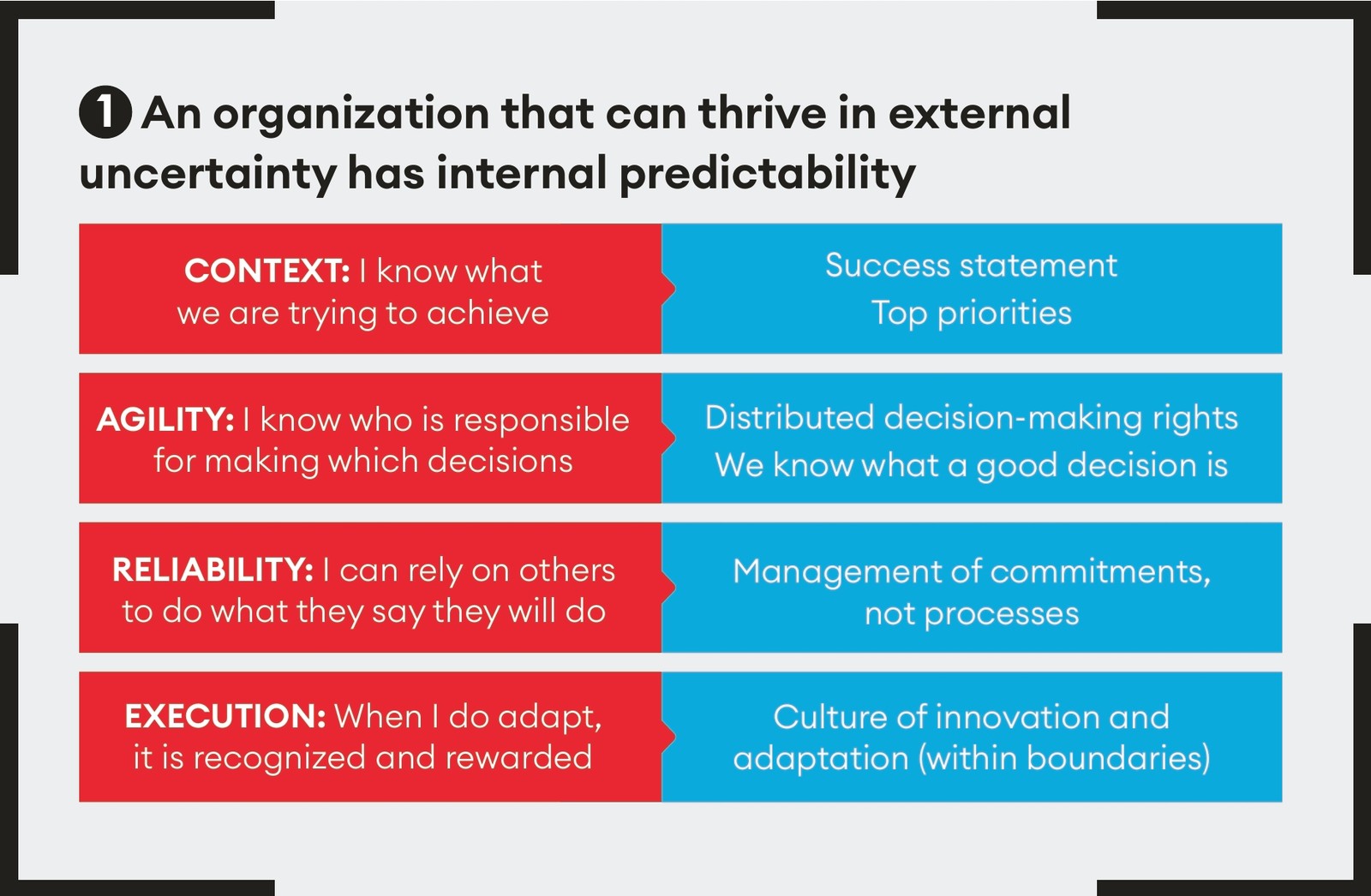
These four principles interact to create trust in an organization, and they can be remembered by the acronym Care: Context, Agility, Reliability and Execution (see Figure 1).
Context: I know what we are trying to achieve and why it matters
To move toward a common goal, team members must understand what they are trying to achieve, why they are working on it, and how the pieces fit together. This is not achieved through long speeches or by posting PowerPoint presentations on a website. It takes real work and commitment.
Most senior executives I work with tell me they communicate all the time and are surprised when data shows how poorly strategy is understood throughout the organization. But frequency of communication is not the problem. With my colleague Don Sull at the London Business School, I conducted a comprehensive survey on execution with over 500 companies and 12,000 senior respondents. We found 90% of distributed leaders agree that top leaders communicate the strategy frequently enough. But only 56% of those leaders could name even one of their organization’s top priorities. Only about half said they could easily explain the organizational strategy. How can so much communication yield so little?
The reason is that communication does not equal understanding; shared context does. High-performing organizations create shared context – the common understanding of what matters, why it matters, how the pieces fit together, and what is and isn’t working.
When team members know what matters most, they can prioritize and make daily trade-offs. Knowing why something matters helps them make better decisions, as they have the context within which to decide.
Agility: I know where critical decisions take place
There is a perceived tension between the need to focus on strategy while also being flexible in adapting to changing circumstances. Agility is sometimes pitched as the opposite of strategic alignment – but agility without strategy is chaos.
Agility presupposes a strategy. It means that leaders can align day-to-day decisions with other leaders without needing oversight, micromanagement or detailed guidance. Agility is making good decisions quickly, aligned with strategy, and then resourcing those decisions appropriately.
When execution lacks speed, people often blame process or bureaucracy – but the issue often stems from a lack of clarity about decision-making rights, or those rights not being distributed appropriately. Say an ideal customer requests unique customization from a team member, but the team member does not know if they can make that decision. They will freeze, say “hold on” to the customer, and ask their boss. Things can continue to escalate until the decision is made – but by then it will probably be too late to matter. Furthermore, those distributed leaders never build their decision-making capability.
Rather than creating multiple processes and checks, speed can be built by articulating a short set of mid-term priorities, then asking for each: “What critical, repeatable decisions must be made to win these?” Then take the time to codify decision-making rights for this set of strategic decisions.
A favorite example of decision-making rights comes from Formula 1. If you think the business world moves fast, in F1, a fraction of a second can mean the difference between winning and losing. One team developed a simple practice to speed up and clarify decision-making: decision rights were owned based on the physical location of the car. If the car was in the factory, rights were owned by the head of operations; if in transit, by the head of the race team; in the garage during a race, by the head of race engineering; and on the track, by the head of race strategy.
When something went wrong, the team did not stall, call a meeting or escalate the problem up the ladder. Instead, they looked directly to the relevant decision-maker to decide what they were going to do or what help they needed. More senior people could give advice or stipulate decision-making criteria, but it was the experts with the best information who made the decisions.
Reliability: I can rely on others to do what they say they will do
Organizations are networks of commitments or promises that extend up, down and across the organization. Alignment must be achieved not just vertically but also horizontally. Having provided units with context so they can act as autonomously as possible, and given them clarity of decision rights, those units need to coordinate with each other across the organization. The things that don’t get done are usually the things that come in from the side. When trust – our ability to rely on others to do what they say they will do – erodes, execution falters.
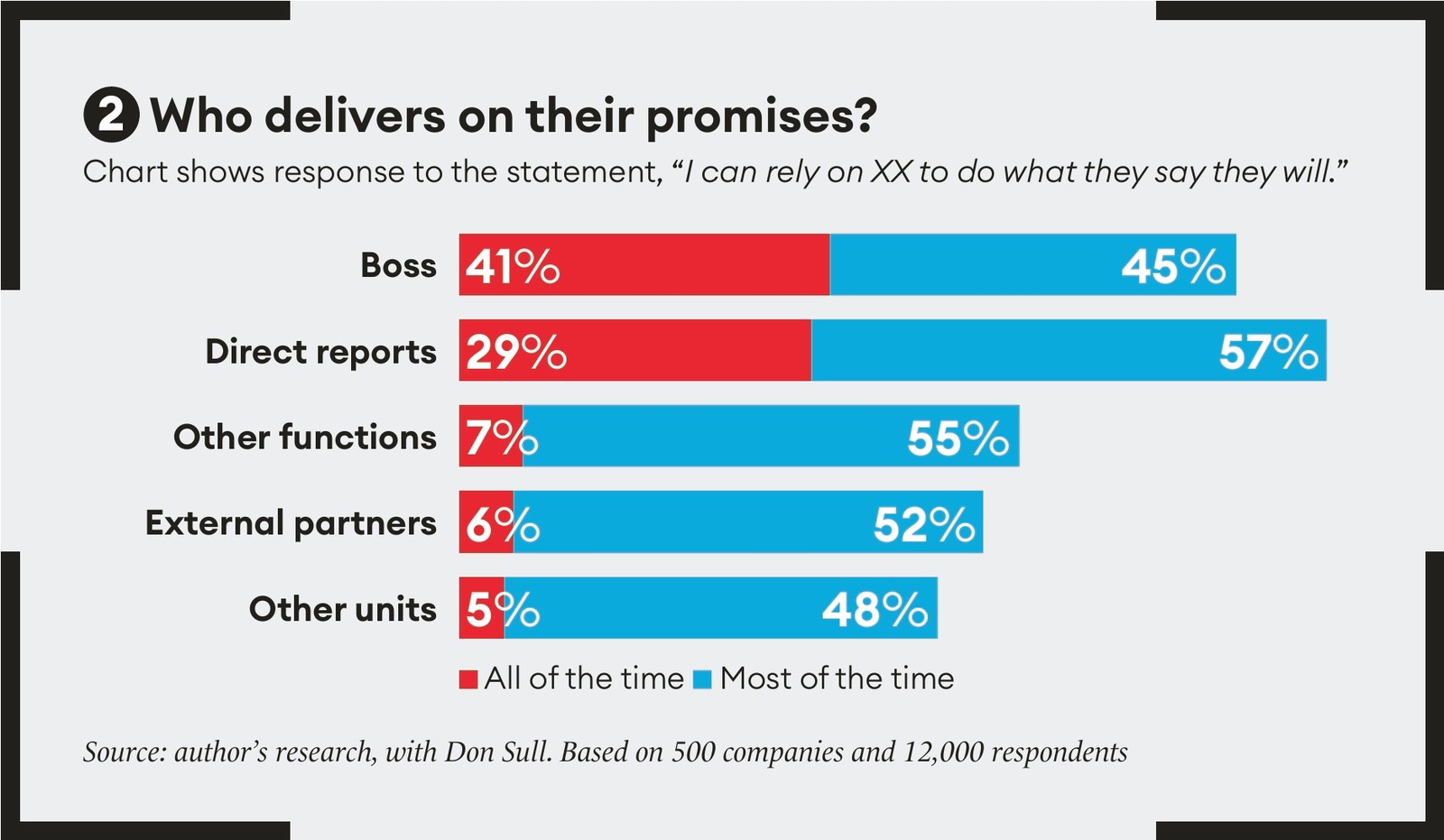
To test trust within their organizations, our execution survey asked respondents how much they could rely on their bosses, direct reports and colleagues to do what they said they would do. Some 86% said they could rely on their boss all or most of the time, and the same was true of direct reports. The percentage fell sharply outside the vertical structure. Just 62% could rely on colleagues in other functions all or most of the time, and only 53% could rely on colleagues in other units. The most sobering finding was that only 5% could rely on a commitment from a colleague in another unit all of the time (see Figure 2).
When reliability is high, team members are free to execute their commitments without worrying that other commitments won’t be met. When we cannot rely on commitments, we do a lot of dysfunctional things. We compensate by doing it ourselves, or asking two individuals or teams to do the same thing. We escalate issues to bosses, call alignment meetings, and spend time sending follow-up notes and chasing calls.
Yet the scariest thing that happens when trust is low is what doesn’t happen because we are too busy following up on commitments. Team members see attractive opportunities, but they are too busy chasing or compensating to get to them.
Reliability gives us adaptability. High-performing organizations can execute with aligned speed while adapting to new insights because they have trust in commitments. When team members trust others to do what they are supposed to, they can focus on value creation – and move faster than others to seize market opportunities.
Execution: when I adapt, it is recognized and rewarded
When crafting strategy, many executives create detailed road maps that specify who should do what, by when, and with what resources. After investing enormous amounts of time and energy formulating a plan and its budget, executives view deviations as a lack of discipline that undercuts execution. But commitment to the plan runs into trouble when reality shifts.
Prussian military general Helmuth von Moltke had grown dissatisfied with the traditional approach to strategic planning when, nearly 150 years ago, he observed that “No plan of operations extends with any certainty beyond the first encounter with the enemy’s main body.”
Free yourself from the notion that everything in the plan will happen. It won’t. Even calling it the strategic ‘plan’ suggests it won’t change – but it will. Changing without alignment is chaotic; changing without communicating is harmful; and changing without having built the capability to change is not possible.
For all the town halls and speeches that CEOs give on the complexities and uncertainties of the current environment, they spend considerably less time talking about how to operate within this environment – and even less time recognizing and rewarding leaders who do.
To achieve this last piece of internal predictability, change must be accounted for as a core part of execution. When leaders adapt and adjust within the boundaries of the strategy, this must be recognized and rewarded. Most organizations focus on hitting numbers on time and sticking to the plan. Team members are rarely praised for stopping or changing something. Leaders who make fast decisions while executing but stay within the set organizational boundaries should be celebrated, especially when the plan is being challenged by market uncertainties.
Shifting the assumption that change is constant, and that organizations should get great at it, involves changing who companies celebrate and reward. Leaders should ensure they give public credit to employees who change or adapt activities to achieve results, rather than simply for hard work or hitting the numbers.
The trust needed to achieve internal predictability
The order of these four principles matters, as each depends on the one before it.
First, team members need clear context: what the strategy is, why it matters and what their role is in executing it. Then, as they execute, they must know if they are empowered to make decisions about the situations they encounter – and if not, where to quickly route them. That means using the commitments or promises that make up the organization: for fast execution to work, these networks need to be reliable. Finally, thriving leaders are those who adapt and make fast decisions that stay within boundaries, especially when the plan is challenged by external uncertainties. As such, they should be celebrated.
Internal predictability is powerful. It means that, even though no one can predict what will happen next, people know how to take in information, make quick and aligned decisions, and execute the strategy. Leadership that builds aligned speed and reliability enables adaptability – and puts organizations on course to thrive amid external uncertainty.
Rebecca Homkes is a strategy and growth advisor, faculty member at Duke CE, and author of Survive, Reset, Thrive: Leading Breakthrough Growth Strategy in Volatile Times (Kogan Page)
Image: Unsplash
