
You have the skills and experience to lead. But
when you talk, do people sit up and listen?
Writing Audrey Clegg

In the thousands of reviews I’ve taken part in over the course of 25 years as a talent and learning leader in major global businesses, there’s a type of feedback that regularly comes up: “This high potential has the skills to step up – but they don’t yet have that essential mix of gravitas, authority and presence they’ll need.”
This is executive presence. We’ve all seen it. It’s when someone walks into a room and before you’ve seen their job title or know what they do, you want to talk to them. That’s the kind of leader we need to cultivate – and it was the focus of our recent work with Duke Corporate Education, which is helping a new generation of Sanofi leaders find the natural authority and presence they need to level up to enterprise leader.
“Bringing out the best in your team is one thing,” says Ryan Eagar, Sanofi’s global head of executive and leadership development. “That’s what our standard management and leadership programs are for. However, to succeed as an enterprise leader, you need to lead without formal authority. You’ve got to work across silos, and bring together different stakeholders to tackle complex challenges. Where those skills are lacking, you get program delays and missed commercial opportunities.”
For Sanofi’s global leadership programs director, Anna Evstropova, timing is a crucial part of the issue. “To really master executive presence, you can’t leave it too late – it’s about dismantling what’s emerging as the default. Once someone has a mature leadership style, it’s much harder to unlearn something as mercurial as presence.”
Drawing on their respective experience of leadership development, Sanofi and Duke CE worked together to create a three-step, 12-month program focused on presence.
Part 1: from self-reflection into intention
In the first part of the program, participants reflected on their leadership journey so far, identifying ways to adapt and energize their personal brand and explore aspirations for the next stages in their careers. Before the program, Lijun Huang was site head of Sanofi China’s plant in Hangzhou, leading 200 people to deliver 350 million boxes of life-saving medicines every year. Drawing inspiration from both pharmaceutical and technology leaders in the region, Huang led digital transformation at the plant. “In just six months, we introduced a collaborative robot line to package drugs with leaflets into a folding box,” she says.
So what was Huang’s intention for the program? “The Hangzhou transformation involved multiple stakeholders at every level,” she says. “Coming from an engineering mindset, I tended to prioritize technical accuracy and data-driven insights. I needed to get better at translating that into a narrative for senior leaders and diverse teams across Sanofi.”
“At the same time, I wanted to build on my leadership foundation – focusing my energy on meaningful impact while also leading authentically,” adds Huang. “I’m Chinese, but I grew up in Germany, so I’m more direct than is typical in Greater China. Being bold for me sometimes is stepping back, waiting for others. I wanted to get better at that.”
Delivering and transforming
Prior to the program, Jonathan Starck was also learning a lot in his first major leadership role. In June 2024, he became Type 1 diabetes franchise head for Australia, New Zealand and South Korea. “Going from managing just two people to leading a team of 13 was a big step,” he says. “Especially as, in addition to my team, I also had to bring multiple stakeholders onboard to hit our goals.”
“The biggest shift for me was going from delivering KPIs, to creating a culture of innovation… So a key goal for this program was learning how to deliver and transform simultaneously.”
Longer term, Starck wanted to push on to a bigger leadership role. “You have to be strategic about that. How do I get the skills I need? Who can help me find the opportunities I need to develop?” He also had a third intention. “When it comes to high-stakes situations, how do I manage self-doubt? Take presenting an annual budget to global leaders, for example… often, I would hear this little voice saying, ‘You’re not good enough for this.'”
Part 2: step forward
Techniques to manage that inner voice were explored in the second section of the executive presence program, which focused on how participants bring their intentions to life.
It had two parts. The first explored ways to build connections to unlock the opportunities participants need to grow – the sort of connections that I picked up along the way during my career, but could have developed much faster if I’d had a roadmap. The second focused on building leaders’ storytelling muscle: a vital capability for influence and impact – and one that, for most of us, starts with the stories we tell ourselves.
Juan Vargas Zambrano is Sanofi’s global medical product lead for polio, pertussis, and some forms of meningitis and pneumonia vaccines. “My confidence used to depend a lot on who was in front of me,” he says. “With more senior people, my language – and my body language – would shift. My inner critic would get all fired up; like, ‘Huh. Take a step back.'”
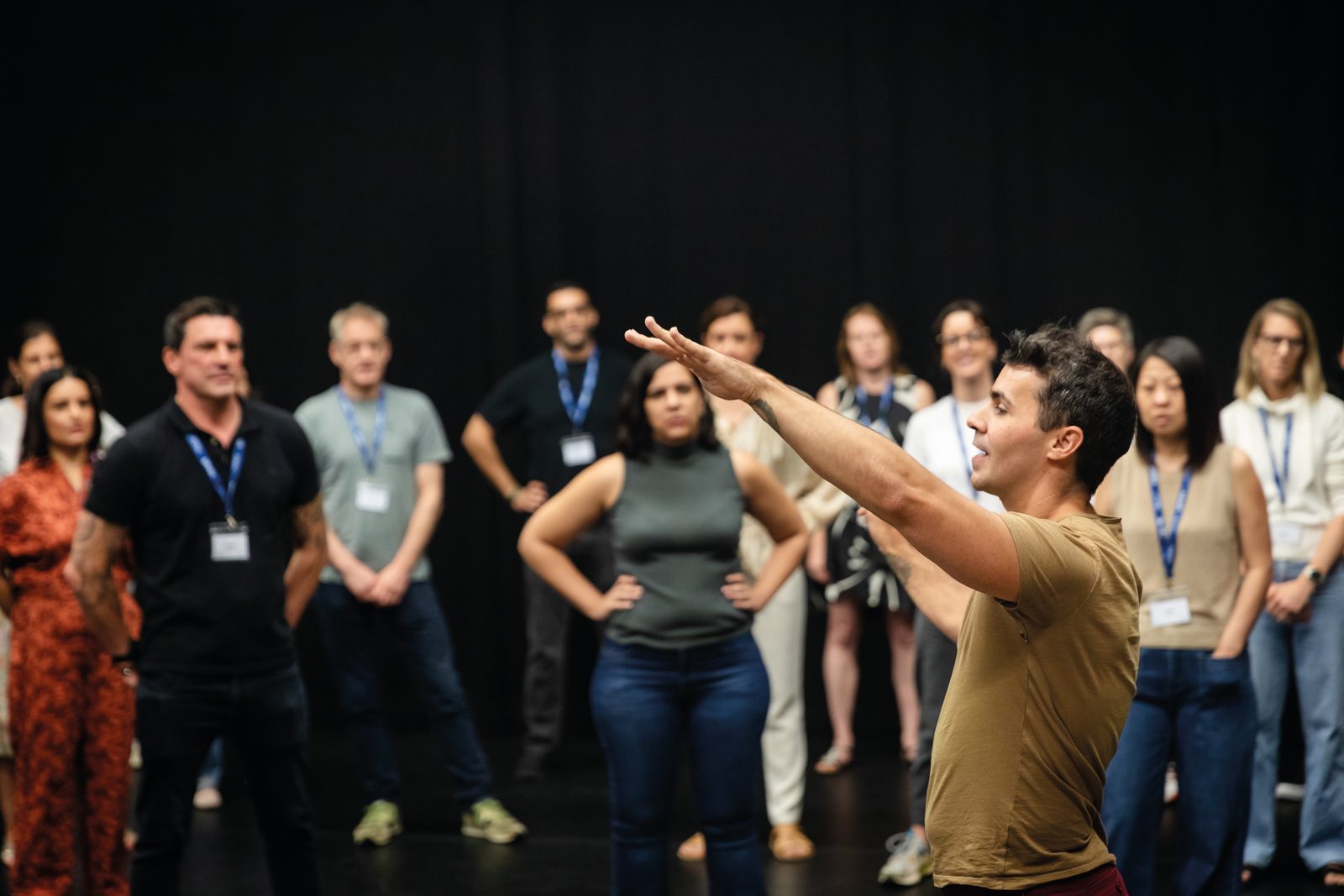
For three days on the program, participants gathered at Duke’s campus in Durham, North Carolina, embedding what they’d learned and accelerating development through a range of one-to-one and group sessions with experts from Duke and beyond.
“One of the most memorable was the ‘Inner Critic to Inner Coach’ session,” says Zambrano. “Working in small groups, we explored how to respond to inner negativity, with simple phrases like: ‘I hear you, I acknowledge you, but I’m up for this challenge.'”
“I could feel the fear release physically – in the shoulders, the breath, the voice. And since I’ve started doing it regularly, I see how it stops the inner critic sinking back into the unconscious to cause more trouble. You create new circuits.”
When Zambrano returned to Lyon, he looked for opportunities to put these skills to work. After being invited to a webinar on intercultural differences, he was asked to lead a workshop with his manager, his manager’s manager, and peers from other areas. “I felt comfortable being myself. And I think that showed. I’m now leading a project to explore more synergies in this space, with sponsorship from senior leadership.”
Stand-out performances
Looking back, Starck reflects on why the time on campus was so transformative. “I still can’t quite work out how they did it,” he smiles. “But some elements stand out: expectations were high and clear from the start. We all bought into that. Also, there’s something about being far from home and a bit jet-lagged. Barriers come down. And the session we did with actors from Olivier Mythodrama (OM) was also very powerful.”
OM was set up by actor Laurence Olivier’s son, Richard, and uses Shakespeare and other great playwrights to explore the art of leadership via stories and characters that mirror our own traits.
“It helped us lower our guards very quickly,” says Starck. “The vulnerability that creates is such a powerful bond. You feel established in the same soil. Intentions take root. You grow together.”
Starck has since applied some of the tactics learned in that session to build trust within his team.
“Rehearsing our annual budget presentation, I asked my team to role-play senior leadership and challenge me hard on the proposals. I wouldn’t have had the confidence to be that vulnerable before. Exercises and conversations like that add up to create the culture we needed to deliver and transform.”
Keeping doors open
For Huang, the learning she put into the storytelling and stagecraft sessions at Duke gave a quick return. Just a few weeks later, she was on stage at a top 200 manufacturing and supply (M&S) leadership session.
“When I stepped onto that stage and paused, connecting with the audience, I felt a profound shift. Thanks to the techniques we’d learned on the program, I was grounded, occupying the space I belonged in. I knew more than ever that presence isn’t about size – a lot of it is about purpose,” reflects Huang.
She was amazed by the response. “Person after person came over, saying how my story had shifted their thinking and inspired them. That authentic moment of connection on stage synced with what we achieved in Hangzhou to become a powerful catalyst.”
A few weeks later, she took on a new role as supply chain head, Greater China. “This wasn’t a direct result of the Presence Program, but what we learned gave me the confidence to aim higher and take on a big challenge.”
Part 3: move the needle
Ultimately, the goal of the program is impact for Sanofi. “We want participants to find or create the opportunities they need to progress toward their aspirations,” says Evstropova. “And as champions for next-generation leadership, it’s important they demonstrate systemic impact within the business.”
Starck worked hard to build good relationships with the leaders he identified in the mapping sessions. Taking on their feedback, implementing it and going back for further discussions gave him credibility and built his reputation.
“When I applied for my first country manager role, two of the leaders I’d reached out to were on the succession planning team and remembered me. The personal story work we did on the program, plus the strength I found in the peer group after the off-site at Duke, really boosted my interview performance.”
He became general manager for UK and Ireland in May 2026 and taps into what he learned on the program most days. “I’m clearer on the value I bring. And that gives me the confidence to step forward and take calculated risks.”
A compass for complexity and volatility
The program’s later phases empowered Huang to lead through complexity and uncertainty while staying true to her authentic self and her leadership principles. “My role sits between M&S and commercial. In the Chinese market, that’s an incredibly dynamic and complex space,” she says. “China’s national volume-based procurement creates a high-stakes competitive bidding environment. Companies compete on both volume and price. Winning can mean volumes surge tenfold overnight – or decline by more than 70% in weeks.”
The different functions have very different lead times, she points out. “Commercial teams face incredible volatility, but M&S require six to twelve months’ planning to deliver.”
Huang tackled this challenge by enhancing scenario planning capabilities and implementing governance processes that connect global and local teams, accelerating communication and decision-making. “We’ve already captured substantial business opportunities for one of our key products, including an €85 million win,” she reveals.
“The Presence Program played a pivotal role in that success.”
Huang’s story is not an isolated one. The first three cohorts of the executive presence program have been very successful. The journey from formal authority to leading through influence can be a long one – but it takes you to a much more productive, engaged and innovative place. The earlier you learn what’s required to build executive presence, the sooner you can master it, and the more impact you can make.
In their unique ways, the program alumni are doing precisely what we need our enterprise leaders to do: working across silos, bringing together stakeholders, and creating a common agenda to tackle complex challenges. That was our thinking behind this program – and it’s great to see the results coming through.
Audrey Clegg is chief talent and learning officer at Sanofi
Images: Sanofi
