
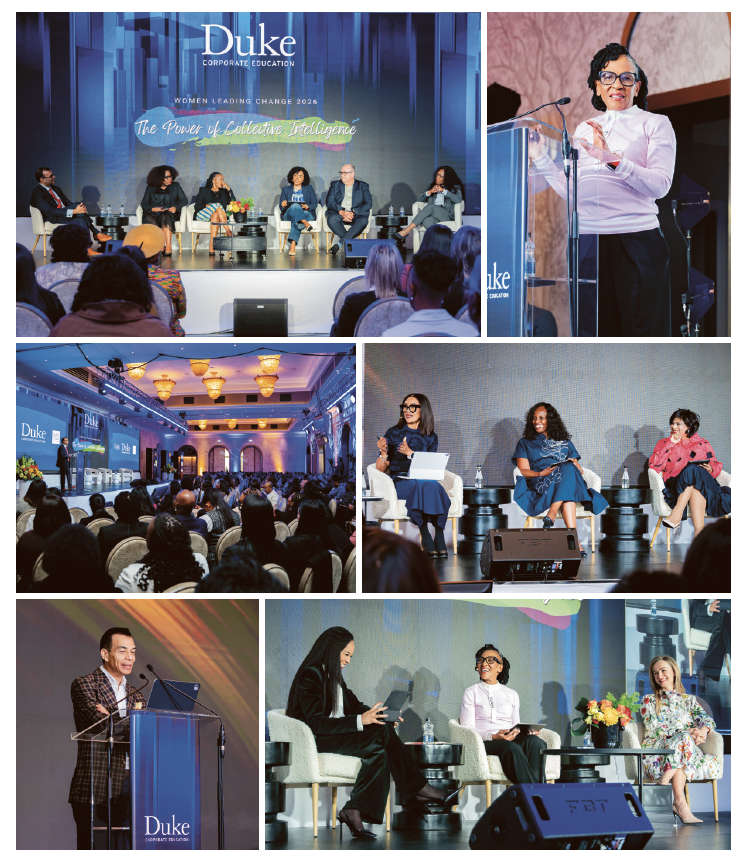
Duke CE’s Johannesburg gatherings explored how leaders can generate better decisions and create greater opportunity
Writing: Christine Robers

Bringing leaders together creates an opportunity to challenge assumptions that can be difficult to see from within a single organization. That was our ambition for Duke Corporate Education’s Human Capital Exchange and Women Leading Change events, held on July 30 and 31, 2026, in Johannesburg, South Africa.
Under the theme ‘The Power of Collective Intelligence,’ we convened leaders from business, government, academia and society to explore how organizations can learn and lead through accelerating change. The Human Capital Exchange focused on the changing relationship between people, technology and organizational performance, while Women Leading Change extended that conversation to the responsibilities leaders carry across institutions and society, as we looked ahead to South Africa’s Women’s Month.
Together, the discussions brought a practical question into focus: how do we create the conditions for different forms of intelligence to contribute? Access to knowledge is expanding rapidly. Our ability to use it well depends on the quality of our judgment and the trust we build with others.
The value of judgment
Opening the Human Capital Exchange, Mary Frances Luce, dean and Robert A Ingram professor at Duke University’s Fuqua School of Business, captured the distinction. “Knowledge is becoming increasingly abundant and commoditized. So then the question is: what becomes more valuable as knowledge is easier to obtain? Our answer is judgment.” Her challenge reached beyond the immediate opportunities presented by AI. What will our institutions need a decade from now? Which assumptions about leadership will we need to unlearn? Those questions ask leaders to consider how today’s choices prepare the people who will follow them.
The agenda placed human and AI collaboration alongside investment in leadership for Africa’s growth, with contributions from Cisco’s EVP and chief people, policy and purpose officer, Francine Katsoudas, Mastercard’s chief people officer Susan Muigai, and MTN’s group chief human resources officer, Paul Norman. The discussion connected technological change with the critical work of developing people and reshaping organizations.
Duke CE’s chief executive Dr Sharmla Chetty carried the question of judgment into Women Leading Change. “The defining question of our time is not whether technology will become more intelligent. It is whether humanity will become wiser,” she said. Her remarks asked leaders to measure progress by whether human judgment and values keep pace with innovation.
Learning for continuous change
For Mastercard’s Susan Muigai, the need for continuous investment in her own growth was critical. In conversation with Shirley Machaba, an International Women’s Forum South Africa board member and former chief executive of PwC Africa, she challenged leaders to treat learning as an ongoing responsibility. As roles evolve, knowledge alone offers limited protection. Muigai emphasized curiosity, learning agility and the willingness to unlearn familiar approaches. People remain responsible for interpreting context and exercising judgment amid ambiguity, even as AI generates more options. “Breadth, not depth, is what will carry us now,” she said.
That provocation was relevant to the gathering’s central theme. Collective intelligence requires leaders who can connect expertise across boundaries, recognize where another perspective is needed and help their teams keep learning. That raises a practical test: are we making room for people to explore beyond the demands of their current role? Preparing for change requires learning that can shape the work ahead.
Trust through action
Trust emerged as a condition for putting shared intelligence to work. People need confidence that their contributions will be heard and that leaders will act consistently with the values they express.
Pumla Molope, president of African Women Chartered Accountants, moderated a discussion on trust as a strategic asset. Advocate Thandi Orleyn, president of the International Women’s Forum South Africa, posed a direct question: “You can call yourself a leader, but do you have people who trust you enough to follow you?”
Orleyn illustrated the point through a service failure resolved when two senior leaders showed up in person to apologize. Their willingness to take responsibility gave the response its meaning.
Margaret Nienaber, Standard Bank’s chief operating officer, reinforced the connection between intention and experience. “If your actions don’t reflect your intentions, you break down trust and relationships,” she said.
The conversation also connected trust with succession. Sponsorship and access across generations give emerging leaders opportunities to contribute and grow. For a gathering centered on women leading change, this was a clear expression of collective intelligence: widening participation in the decisions that shape organizations.
Accountability for what comes next
The board discussion, moderated by Duke CE’s president of global markets Vishal Patel, addressed the conference’s themes through the lens of governance, with insight shared by Tsakani Maluleke, Auditor-General of South Africa; Jeanett Modise, group chief people officer at Absa; Gabriel Swanepoel, division president, Africa, at Mastercard; Mabedi Mufahothe, senior manager: technology value and innovation at MTN; and Lucretia Khumalo, divisional executive, client support and growth, at the Industrial Development Corporation of South Africa. They explored questions about the oversight and accountability required as AI reshapes organizations, pointing toward the adoption of broader measures of progress. Boards need to consider how people’s skills and roles are changing, alongside whether employees and stakeholders trust the systems being introduced. Adoption figures alone offer an incomplete picture of organizational readiness.
The connection between business performance and societal wellbeing also matters. Sustainable progress depends on how leaders combine innovation with integrity and empathy, and how they build the organizational habits that allow technology to create lasting value.
Convened by Duke CE in strategic partnership with the International Women’s Forum South Africa and African Women Chartered Accountants, the events created space for these questions to be examined across sectors and generations. The setting and perspectives were African, with implications for leaders everywhere. That speaks of Africa’s contribution to global leadership, beyond mere participation in international conversations.
The gatherings reinforced a fundamental principle: collective intelligence is not simply about bringing different perspectives into the room. Its true value lies in translating those perspectives into better decisions, stronger institutions and meaningful opportunities for others. For leaders across Africa and beyond, the challenge is to ensure that technological progress advances alongside human development, that innovation is guided by sound judgment, and that leadership creates pathways for future generations. The responsibility now is to carry these conversations into the everyday decisions that shape our organizations and societies.
Christine Robers is chief marketing officer at Duke Corporate Education
Images: Duke CE
