
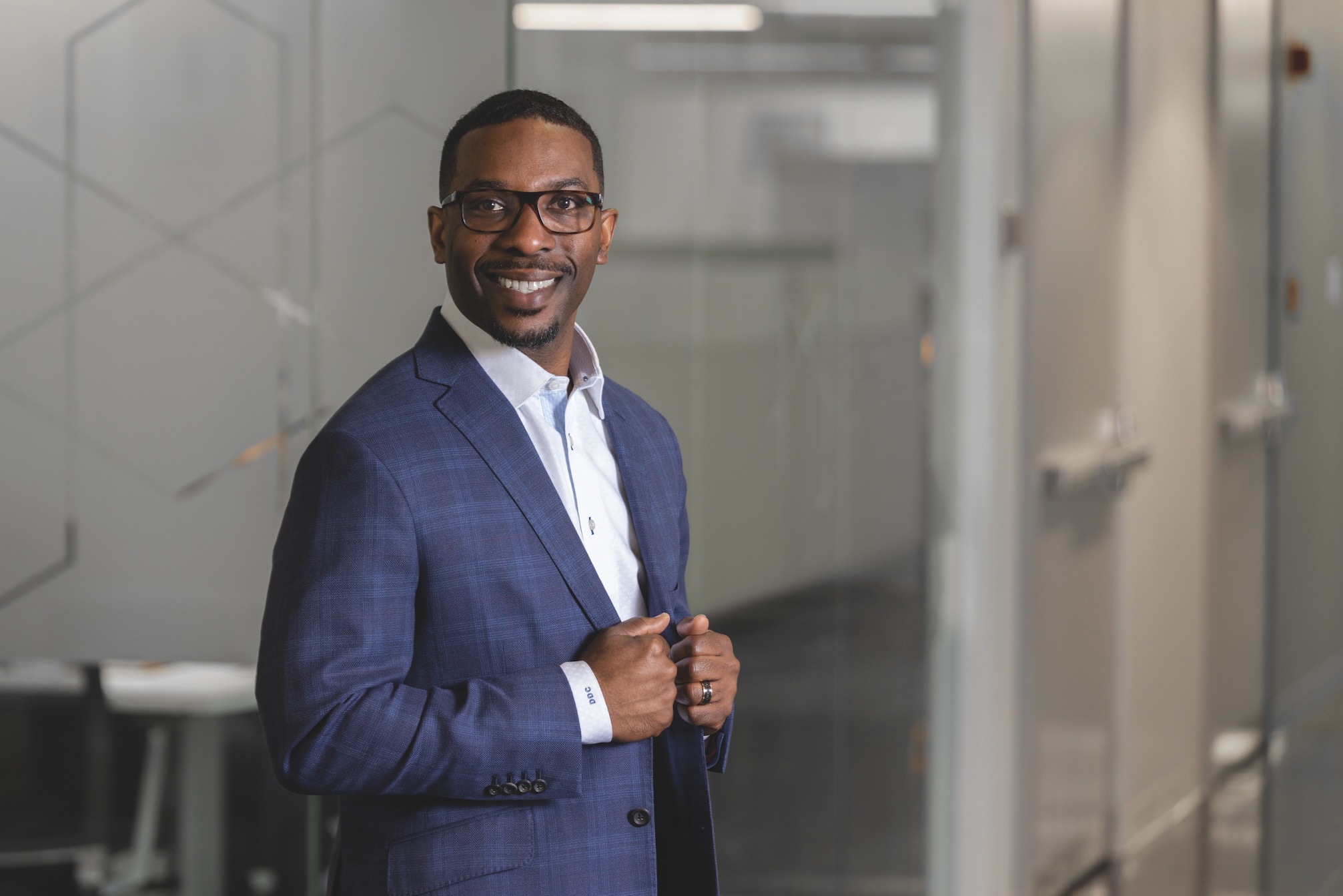
CHROs need to walk alongside their C-suite counterparts, not one step behind, says AbbVie’s D Crum
Writing Patrick Woodman & Vishal Patel

“My vision – my dream – is HR as an enterprise engine: a value creator, not a support function.” Demetris Crum, known as D, is executive vice president and CHRO at AbbVie, the global biopharmaceutical company – and a passionate, persuasive advocate for HR playing an expanded role in the era of AI.
For starters, HR needs to forget the tired old refrain about earning a seat at the table. That belongs to the past. “We all have a seat at the table. The question is what you’re doing with that seat,” argues Crum.
Nomenclature matters: HR needs to rid itself of language that describes it as a support function, putting a false ceiling on its contribution. “I really want us to move from HR supporting the business, to HR shaping and partnering with the business,” says Crum. “That means an HR function that helps the company anticipate change, make better talent decisions, and ultimately deliver the outcomes the business needs to win in the marketplace.”
HR can’t be one step behind, merely reacting to others. “CHROs need to be in step with leadership,” says Crum. “The best HR leaders are in the room alongside leadership, at the moment decisions are being shaped, thinking about all the things they might not be thinking about.”
Finding purpose
Crum’s approach reflects clarity about HR’s purpose in modern business, at a time when business itself is being transformed by a raft of emerging technologies, especially AI. How, we ask, is AI changing the strategic challenges facing CHROs?
“I put this into 2.5 categories,” answers Crum. “The first is the impact on the CHRO functionally – within the HR function itself. How will it change your operating model? As it creates capacity for your team, how are you thinking about what they should be doing with that capacity? How are you looking at HR work processes? How are you thinking about your customer experience – the HR tools, processes and solutions you provide for employees and for leaders in the organization?”
The second category is the business impact. “The first part, there is talent. How are we evolving the skills of our current talent? How are we creating a culture where employees are adapting, and adopting AI in their everyday work?” Then there are questions about future skills. “Are you evaluating your hiring profiles against those future capabilities? Are you influencing the business as they continue with everyday hiring to ask: ‘Will this role look the same tomorrow?’ That rigor is important.”
Crum’s final half-category is about how CHROs help organizations anticipate the future of work to deliver long-term value. “You could say that culture and leadership falls under business impact, but I think it’s so important that it needs its own swim lane,” says Crum. “Leaders shape culture, so as we adopt AI, it’s important that we’re spending time with leaders, creating focus on the human element – on being change-ready leaders, not just regarding AI, but technology in general.”
How, though, can CHROs bring that perspective? We’re in unknown territory: nobody has a map for the change being unleashed by AI. “It’s not so much about the experiences we’ve had, but being able to navigate waters we’ve never been in before,” says Crum.
That is a much-needed capability – one that HR needs to help organizations discover and develop among its leaders, understanding what potential looks like in the future. “To me, potential is really about curiosity, people’s ability and judgment when dealing with ambiguity. How do they navigate in that new space? That’s why I call out that 0.5 category.”
Change and continuity
Crum’s career spans almost 25 years in HR, following undergraduate studies in human resources at Michigan State University. Much has changed since then, we reflect. What has been constant – and what has had to be jettisoned or reinvented?
“Development and differentiation of talent have stayed extremely important; how you invest in talent and give transparent feedback still matters. The CHRO architecting culture, evolving it over time, and expecting leadership to model and continue to shape it – all of that remains important.”
The biggest change is around the role of experience in understanding potential and developing talent, within HR and among leaders more widely. “Historically, we’ve built judgment based on the experiences people accumulate over time: when you get to a senior role, you’ve seen a great deal. That breadth of experience remains essential, and so is the ability to adapt to a landscape that may change considerably in the next 18 months.”
That shift demands a more tailored approach. “We have to be more nuanced for every leader. What is the question we’re trying to answer about this individual, and what experiences do we need to create for them to answer it?”
Ownership of this agenda has to be shared, argues Crum. It is a prime example of how HR and leadership should work in tandem. “Leaders have to understand and be held accountable for owning the talent agenda; HR has to be accountable for making sure leaders are making good talent decisions,” he explains.
AI’s impact
We turn to the wider implications of AI. What are the opportunities for expanding its impact in practice in the next two to three years? “If I talk about AbbVie, it’s about our mission and what we can deliver for the patients we serve,” says Crum. “What do we do here? We discover therapies, we develop and manufacture those therapies, and then we elevate standards of care by getting them to the patients we serve. Where we can harness the power of AI across all of those areas, that, to me, is the passion we hold collectively.”
Under Crum, AbbVie’s HR organization is shaping that agenda with senior leadership through varied initiatives: not only ensuring that AI is part of its own everyday work, but establishing an AI Capability Lab to drive continuous enterprise learning, and – crucially – building a culture of trust around AI.
In a field that relies on highly educated specialists, there is potential for resistance to a technology that some might perceive as devaluing their expertise. Yet that has not proved a concern in practice: clarity of purpose around how AI should be used has meant that employees have been open to it. It’s an object lesson in AI adoption.
“We moved quickly from saying, ‘Go use it,’ to connecting it to ‘why,'” recalls Crum. “Aligning conversations about AI use to the larger AI adoption goals across each function helps provide a path to the why and to what we’re trying to achieve with AI.”
Culture in service of performance
Clarity about what the business is trying to achieve is also essential to any discussion about corporate culture. AbbVie prides itself on being one of Fortune’s 100 Best Companies to Work For and on being recognized over many years by the Great Place to Work® organization. But what will shape a consistently high-engagement, high-performing culture as AI transformation accelerates?
“It starts with having a really good definition of culture,” says Crum. “For one thing, it is unique to organizations – and it has to be seen through the lens of the business’s goals. Culture is in the service of performance,” emphasizes Crum.
Yet while business is changing fast, the ingredients of a strong culture will endure. “Even in a highly technical world, you have to be clear about expectations and clear about your North Star. It’s clarity, trust, accountability and shared purpose.”
Nevertheless, tensions are inevitable. For one thing, transformation rewards speed, which may clash with other priorities. How do leaders reconcile such tensions? Crum recognizes the challenge. “It comes back to first principles. Culture in the service of performance – that’s your anchor. It requires leaders who can navigate change, who know when and how to pivot, and how to build clarity around the ‘why’ – why something may need to change, slow down, or speed up.”
He describes this as managing polarities, and points out that ambiguity and uncertainty are inherent. “It’s not that one side is wrong and the other right – you can find reasons why each side is right. But when you get back to your first principles and think about leading through change – knowing what to do when you don’t know what to do – that’s when you make the trade-offs between those polarities, in the service of delivering the performance that’s needed.”
Four Fs
Crum’s clarity about today’s business challenges is evident. He is equally clear about what gives him balance and energy beyond work. “I have my Fs: faith, family, fun and fitness,” he explains. “My faith keeps me grounded spiritually. My family – well, I love my family, and my goal after retiring is to still have them love me! Spending time with them and disconnecting in the right way is really important.”
For leaders in high-pressure roles, time to relax or invest in fitness is easily squeezed out. “I’ve really learned – especially through Covid – that your wellbeing is very important, so you can bring your best self to the areas of your life that matter most, both at work and at home.”
Bringing one’s best self to work gets easier when the work is engaging and rewarding. What fires him up about the challenges of being CHRO in a business of some 57,000 people?
“What excites me most is the people element,” says Crum. “The biggest competitive advantage we have is our people. How you invest in, develop, and allow people to achieve their full potential – wherever they may be in the organization – and build that around clarity, a moral compass and integrity: that is what keeps me excited about the CHRO role.”
Our conversation concludes on a strongly optimistic note. “I hear it every day: there has never been a better time to be in HR. I will always agree with that, but I will also say, it is a navigating time, a figuring-it-out time. And that’s exciting!”
“We are in a moment that I would hope no HR leader would want to miss. We have the chance to make a path for the future and define the value that HR can bring to the businesses we help shape.”
Shaping, not supporting, the business, with people at its heart. In a world in flux, Crum’s vision of HR is a compelling blueprint for CHROs contributing to organizational success.
Patrick Woodman is editor of Dialogue. Vishal Patel is president of global markets, Duke Corporate Education
