
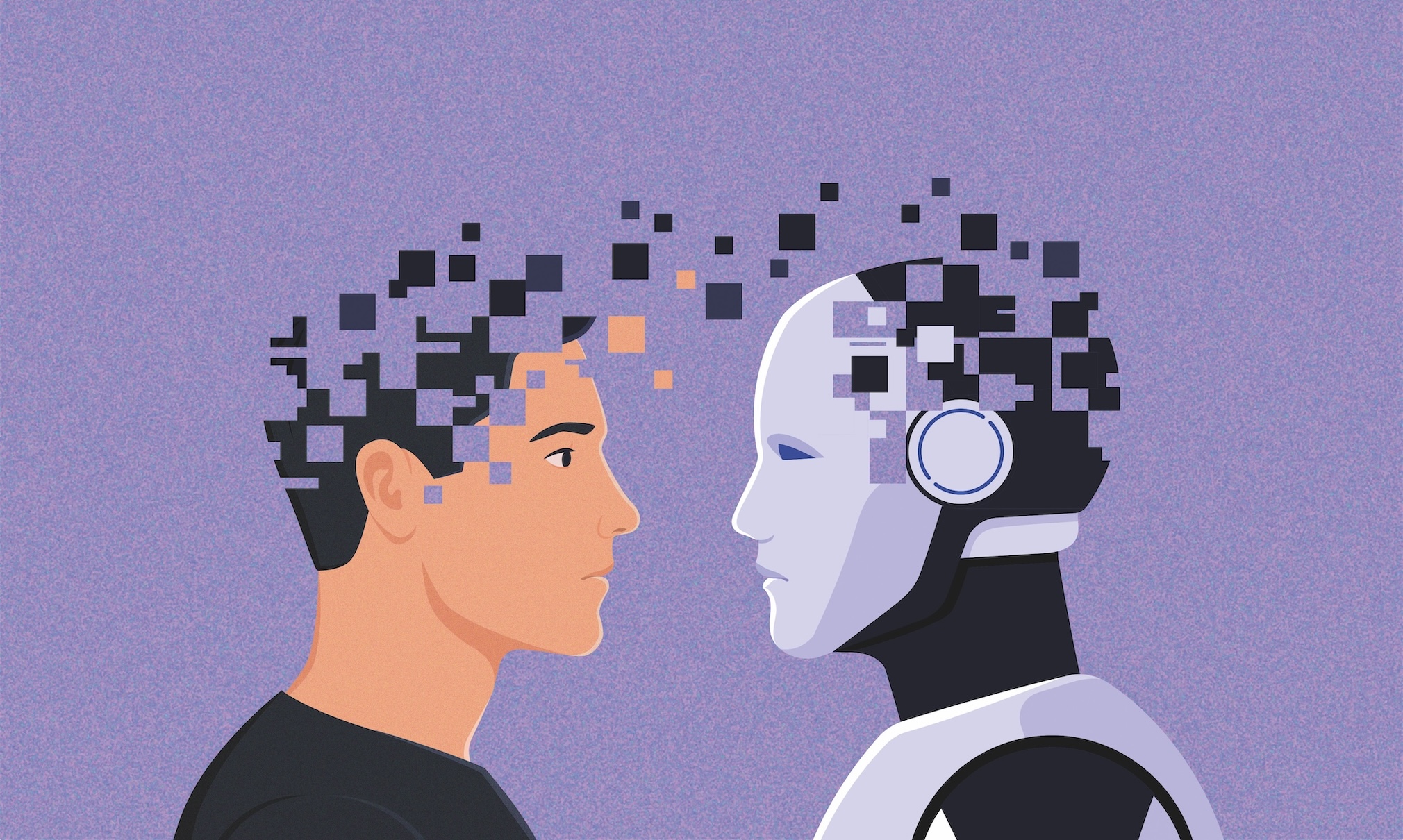
Organizations will suffer if employees devolve critical thinking and judgment to artificial intelligence
Writing: Nicole de Fontaines

Generative AI now sits quietly inside everyday workflows: drafting emails, summarizing reports and scheduling meetings. A significant question for leaders is no longer whether AI will be adopted – or whether it will take our jobs – but how it will impact the way people think. As AI becomes more powerful and more embedded, there are real grounds for concern about the phenomenon of cognitive offloading.
Cognitive offloading occurs when people rely on external tools to perform mental tasks they once did themselves. It is natural and advantageous for humans to cognitively offload some things – however, with GenAI, there is evidence that employees are going far beyond offloading calculation, analysis or data retrieval. The recent CEMS report, Augmented Leadership: Navigating the New Age of Intelligence, notes that people are now “outsourcing even the smallest decisions to GenAI – from scheduling, to choosing outfits or meals.”
In doing so, employees risk eroding the critical thinking that makes them valuable. This matters profoundly for organizations. A workforce that defers the majority of its judgment calls to algorithms may appear efficient, but it can quickly become fragile. Overreliance on AI, the report warns, has emotional as well as cognitive consequences: “detachment, reduced confidence, and a diminished sense of purpose.” When people stop thinking, they stop feeling ownership of their work.
The risk demands that organizations and educators focus not only on technical skills, but, critically, on the cognitive risks and opportunities created by AI – with a strong emphasis on critical judgment and self-awareness.
Why leadership must set the tone
Artificial intelligence does not arrive in organizations as a neutral force; it is shaped by incentives, norms and role modeling. Leaders set the tone for how tools are used or misused. If speed is rewarded above reflection, autopilot thinking will follow.
“Thinking must come before prompting,” explains Guillaume Delacour, global head of people development at ABB. In his organization, leaders actively tell employees: “Think first, prompt second. Build your own ideas, structure your thinking, and only once you’ve hit your limits, then turn to AI.” AI becomes valuable only after human reasoning has done its work.
This principle challenges the common misconception that digital natives will naturally excel with AI. In reality, judgment matters more than technical fluency. A graduate whose only skill is prompting a chatbot offers an organization little that a manager couldn’t obtain directly. Today, what differentiates talent is not access to AI or technical skill, but the ability to question, interpret and apply its outputs.
From managers to strategic directors
One of the most useful ways of reframing leaders’ role was suggested by Aleksandra Kjemhus, CEO of Black Door Technology. In an AI-augmented workplace, Kjemhus explains, the focus moves “from execution to deep thinking about purpose, audience and message, then guiding AI toward that vision.”
This is a subtle but important reframing. AI removes the specter of the blank page, but it does not replace the need for strategic direction. Someone still has to decide what matters, what quality looks like, and what should not be done at all. In this sense, AI is “a tool, not a colleague.” Treating it otherwise invites complacency.
Leaders who function as strategic directors tend to do three things well. Firstly, they insist on clarity of purpose before technology enters the conversation. Secondly, they interrogate outputs rather than accepting them at face value. Thirdly, they model restraint. Responsible use requires that people, not AI, are in the driver’s seat.
Designing against autopilot
Combating cognitive offloading is certainly not about banning AI. It is about designing work differently, so technology is used to accelerate brilliance. “Critical thinking is like a muscle,” Kjemhus notes. “It weakens without exercise.” Leaders therefore have a key role to play in creating environments where thinking is practiced constantly – expected, visible and rewarded.
This can be as practical as building in pauses before AI use, asking teams to define the problem and success criteria first. It can involve assessing not just outputs, but the reasoning behind them. It also requires ethical literacy. “Make sure you ask – what’s the source? What biases might be in the model? How do you cross-check outputs?” asks Delacour.
Crucially, ethics is not a technical add-on. Kourosh Bahrami, CEO of Tesa, makes the point strongly. “We must remember that ethics is not a ‘digital subset’. It is the same foundation of responsible behavior that has always guided good business.”
Keeping humans in control
We can be hugely positive about AI’s capacity to transform the world of work. It can undoubtedly amplify human potential, enhance creativity, and unlock new possibilities. “AI now adds a new dimension: it enables people to be more creative, more innovative, and quicker to learn,” says Bahrami.
Yet as AI’s impact grows, organizations must keep in mind a fundamental truth: people come first. Evelyne Léonard, professor at Université Catholique de Louvain, captures the core message succinctly: “Don’t let AI be your master. Be AI’s master.” AI is a tool, not a substitute for judgment.
In the age of augmented leadership, the most effective leaders will be those who protect judgment, cultivate creativity and ensure that convenience never replaces human thought.
Nicole de Fontaines is executive director of CEMS, the global alliance in management education
