

Businesses unlock vast value when they help customers realize their true aims

Whatever you sell today is not what your customers want. Commodities, goods, services and even experiences merely offer the means for the ends that customers really desire: to be transformed.
To be healthier, wealthier and wiser. To have meaning in their lives and purpose in their businesses. To flourish as human beings and thrive as enterprises. To become who they want to be.
Transformations are a distinct economic offering, the fifth and final category in the Progression of Economic Value model that I defined with James H Gilmore as long ago as 1999. They’ve always been around – but as lower-level economic offerings increasingly become commoditized, transformations come to the fore. We are beginning to shift into a transformation economy.
Why is this happening? Thanks to the productivity and technology improvements that began with the Industrial Revolution, people
in the developed world today live lives of abundance. We have what once was unimaginable. Therefore, the opportunity cost of our time has
grown dramatically. We only have so much time; it has become our most precious resource. Commodities, goods and services all save our time so we can spend more of it enjoying, learning, doing and just being in the countless experiences available today. (See my previous article with James H Gilmore, ‘Competing for Customer Time’, Dialogue, Q4 2021.)
Transformations, however, enable us to not just spend time, but to invest time in our future selves – with companies using experiences as the raw material to guide us in achieving our aspirations.
On the supply side, the emergence of the transformation economy is also the result of business’s constant search for differentiation, lest their offerings be commoditized. Transformations impart the ultimate level of value for they recognize that the customer is the product. The outcome of transformations are customers that become who they want to become. Everything else is just input. Such businesses prove difficult to imitate and resist commoditization, for customers are inherently unique. What’s more, the value companies create within each customer can yield greater profits.
From experiences to transformations
This shift has been happening for a long time, but it accelerated with the Covid pandemic. Coming out of it, we finally could have the experiences we craved for so long. That’s why whenever an experience opened up, it filled to capacity – and why we continue to spend our hard-earned money and precious time on largely recession-proof experiences. Consider their progression.
Memorable experiences Experiences are memorable events that engage each individual in an inherently personal way. If customers – ‘guests’ is the best term – don’t walk away with a memory, it isn’t an experience. To create memories, the offering must be engaging, reaching inside people and affecting them emotionally, physically, intellectually or spiritually.
Meaningful experiences It was also in the pandemic’s wake that we realized it wasn’t just creating memories that we missed, but the meaningful time we spent with family, loved ones, friends, colleagues, and even complete strangers at inspiring collective happenings. Meaningful experiences add a level of significance to us as individuals, going beyond engaging who we are to connecting with our identity.
Transporting experiences These transport us out of ourselves, through awe, flow, or euphoria. They instill wonderment, shift us beyond the present space or time, and move us metaphorically to another realm, to a transcendent and liminal space and time.
Transformative experiences Simply put, transformative experiences change who you are. Sometimes, it is that one rare life-changing experience, but more often, transformations entail a series of experiences – memorable, meaningful and transporting – that create the conditions under which people (and businesses) change themselves. Change is difficult to accomplish on our own, so we hire companies that know how to make it happen – whether to go from poor health to having wellbeing, from financially insecure to prospering, from being uninformed to highly competent, and even from feeling insignificant to having meaning. Such from/to statements are a hallmark of transformations – and they can apply not just to consumers, but to employees and businesses.
Transformations, therefore, are effectual outcomes that change individuals in a sustained way. To guide transformations, you must continue to work with customers – ‘aspirants’ is the best term here – to not only achieve their outcomes but to ensure those changes last into the future.
Consider Burning Man, filled as it is with peak experiences, flow, and awe. At the end of each annual event every participant, to a person, declares: “Burning Man changed my life!” In fact, the organization recommends that Burners, as they now call themselves – signifying their change in identity – not make any major life decisions for at least two weeks afterward.
Ah, but what happens when participants return to their daily life? The new memories, knowledge, and behaviors dissipate over time. You do not truly transform your customers unless the changes are sustained through time.
Encapsulating experiences
Sustaining change over time – and developing a full transformation offering – requires that guides encapsulate experiences. This is done through three activities: preparation beforehand, reflection afterward, and integration on an ongoing basis (Figure 1).
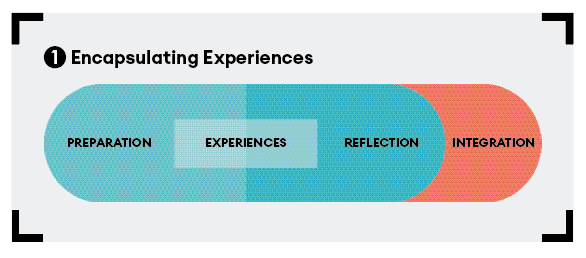
Preparation helps aspirants imagine the experience in advance, understanding its transformative implications and its potential effect. It puts them in the right frame of mind, so the experience can have greater impact.
Reflection means asking a series of questions about what happened, what effects it had in the moment, and what further impact it could have in the future. This retroactively enhances the value of any experience – and it is much more powerful in combination with good preparation.
Recognize that the experience itself is an integral part of encapsulation – don’t think of preparation and reflection as ‘bolted on’ to the experience. Rather, they flow together to create one offering. Integration then continues that flow by putting reflection into action, enabling aspirants to do the hard work of bringing change into their life or business, under your guidance. By guiding and sustaining the transformation through time, it shifts transformative experiences into full transformation offerings.
The Delta Model
The Delta Model represents how transformation guiders can make the shift to providing full transformation offerings (Figure 2).
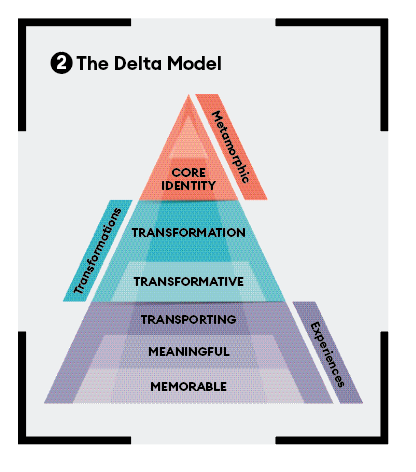
The lowest segment shows how transporting experiences create more value than meaningful experiences or merely memorable ones. Transformative experiences emerge above these, yet they are not full transformations. Only through the integration of the series of experiences can they be sustained through time and yield the fulfillment of each customer’s aspiration.
Finally, the top segment signifies that some transformations are so life-altering – or employment- and business-altering – that they yield a metamorphosis: a permanent transformation in some core aspect of identity.
It’s well known that having a baby forever alters mothers physiologically – and research shows the same is true for fathers. That metamorphic transformation may not seem very business-related, but think of the money spent on parenthood before, during, and after delivery. Yet is there any parent that truly feels prepared for the responsibilities of having and raising a child? Is there not a business opportunity here? No company involved, from hospitals to diaper manufacturers, offer such transformations.
There are many other metamorphic transformations that also offer great business opportunities, including every level of education, from kindergarten to PhD, not to mention getting that first job, joining the army, getting married, becoming a manager, starting a business, retiring, and so forth. But how many financial ‘service’ companies go beyond helping with the finances to guiding customers in their journey into a completely different phase of life? Of all these examples, perhaps the only one where an organization effectively transforms almost every person that comes to it is the military: think of the US Army and its boot camp, and then of how that pales in comparison to the Navy Seals. Human beings are capable of incredible transformation if – and only if – they have the right guides.
Most of these examples come out of a desire to change in some way, shape, or form. One of the most frequent catalysts for change is trauma – perhaps a cancer diagnosis, a severe car accident, losing a loved one, or being fired from a job. Here, the trauma immediately changes you; the challenge is to transform back to whole, albeit as a different person. There may be many companies involved in the aftermath of such trauma, but few, if any, metamorphic transformation guiders.
All transformation is identity change, and in addition to metamorphoses, there are many other opportunities for transformations in non-core or peripheral aspects of identity that comprise the middle segment of the Delta Model. Aspirants may want to gain a refinement of some aspect of identity, whether on a personal, professional or organizational level: perhaps to learn more about wine, to become more adept at work, or to be more efficient in answering customer queries.
On a larger scale, aspirants might want to attain an ambition of expanding themselves: becoming a single-digit handicap golfer, a better user of AI, or a more customer-focused company.
Or, they may desire to enrich a cultivation for new, but non-core, aspects of identity: becoming a gardener, gaining a certification, or innovating a new offering.
Harnessing the Delta Model
Embracing the Delta Model may seem a very distant and impractical possibility for many commodities, goods, or even services businesses. Remember, however, that whatever you sell today is but a means to the end of what your customers really want. So start by embracing the manufacturing technique of ‘asking five whys’ – questioning your external customers to ascertain what they aspire to become. Ask them why they buy your offering, whatever it is. And why they want that. And why they want that. And why, again and again – however many times it takes to get down to a core aspiration.
Such analysis lets you think more deeply about how your offerings contribute to customer aspirations, collectively (if you do the right research) and individually (if you have the right design tool to mass customize your offerings). Perhaps then you can design one or more offerings that subsume what you currently sell into a transformation offering.
Even if you can’t imagine going that far, the sequence of whys can prove valuable: every step along the sequence can yield valuable information that you can apply to your business. If you can’t guide transformations, you may partner with other companies that do the full transformation, or even just determine how your current offerings can create more value for aspirants as the authors of their own transformations.
You can at least become more transformational – and the further along the sequence of whys you go, the greater the value you create, even if you don’t guide customers in achieving their core aspirations at the end of the chain.
As a manufacturer, for example, you may find that there are services you could offer – such as taking over the ownership and management of your goods to help clients improve alignment across the organization – or even experiences,
such as workshops on how to use your goods to better effect.
If you’re already an experience stager, you may want to first see how you can shift up the Delta Model. Use customer research to determine what types of transformations you could guide, from enhancing refinements to expanding ambitions, enriching cultivations, and perhaps even altering metamorphoses. The higher your reach up the Delta Model, the greater the value of your offerings.
And whatever the genre of offerings you have today, do not neglect the opportunities for guiding transformations for whatever communities you or your customers interact with – whether families, neighborhoods, locales, suppliers, investors, or the general public and society at large.
The transformation economy speaks to customers’ greatest desires and their dreams for the future. To remain relevant in this new economy, businesses must think more deeply about how they foster human flourishing; about how they can help customers achieve better health, greater prosperity, new learning and meaning in life; about how they help their customers become who they want to be.
B Joseph Pine II’s latest book is The Transformation Economy: Guiding Customers to Achieve Their Aspirations (Harvard Business Review Press)
