

Prepare now if you want your organization to survive – and thrive – in the face of accelerating technological disruption
Writing: Alberto Torres

Early in 2009, I received a call offering me a position on Nokia’s top executive team. I had joined the company five years earlier, leading corporate strategy and various businesses. In those years, I saw Nokia grow from under €30 billion to over €50 billion. Yet after a flat 2008 – with Nokia still at the top of the mobile industry by most indicators – 2009 felt like a crisis. It would be the start of one of the most consequential disruptions in business history.
In retrospect, the signals had been clear. Apple had launched the iPhone two years earlier. Android was gathering momentum. The market was moving toward smartphones – a technology that Nokia had invented, but others had perfected. Nokia had many cards to play, but had been, and would remain, too slow to make drastic moves. I was called because I had been among those who had advocated for change. Yet two years later, I left the company, frustrated. After 2011, the decline accelerated, destroying a once-great tech giant.
The story of Nokia has been told many times and now feels remote. But it is not unique – think of Kodak, Blockbuster, DEC, Yahoo, AOL, Toys R Us, and Tower Records. The patterns that destroyed them persist. Companies rarely collapse because they are poorly managed. More often, it happens when they are managed exactly as they were designed to be – efficiently, rationally, and in alignment with a business model that is about to become obsolete. As disruption sneaks in, with high uncertainty and little early impact on the business, incumbents often act rationally and continue on their current course at full speed – until it is too late.
Today, artificial intelligence and other new technologies threaten companies that, like Nokia then, look utterly solid – companies run by highly competent people. Perhaps your company is one of those that faces an existential threat. Understanding the patterns of disruption matters. Beyond the particulars of every failure and success, there is a structure, and there are clear lessons to be drawn that can help you survive and thrive.
Disruption has a pattern
For decades business leaders have been taught to think in S-curves. New technologies emerge slowly, improve through experimentation, then accelerate sharply once an inflection point is reached – when price, performance and usability align with mainstream demand. Eventually they plateau, as markets mature.
The S-curve is one of the most enduring patterns in business, but so is the pattern of our reactions. Linear thinking leads us to believe early hype, expecting rapid progress that is not possible. Hype is followed by disillusionment, when we begin to dismiss the technology for failing to meet our own inflated expectations. When a successful technology reaches its inflection point, we are often surprised by its rapid rise.
In a technological disruption, an incumbent technology is replaced by a newer, superior one that follows an S-curve. The disrupted technology follows the inverse pattern. This is what I call the Z-curve. Early on, the disruption sneaks in, barely perceptible. Yet when the inflection point is reached, the decline becomes obvious as it gathers speed.
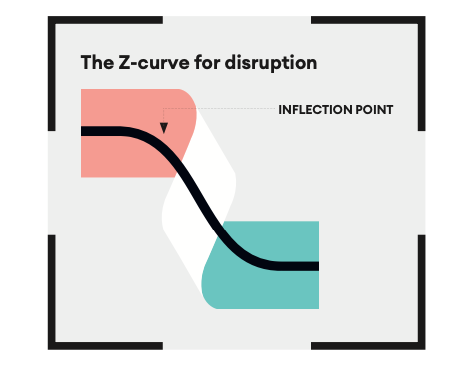
After the inflection point, when the decline accelerates, the range of viable options collapses. This begs the question: why do so many incumbents fail to act before the fall, when there is more time and more opportunity?
In its early stages, the Z-curve is easy to dismiss. Initial concern often mirrors the hype of the new technology; when the effects are not immediately visible, relief tends to follow. Uncertainty is high. Financial performance often masks any underlying problems. Experienced leaders disagree about the threat and the appropriate response. Boards and key stakeholders resist radical change.
Disruption is not dangerous because it is sudden. It is dangerous because it is gradual – until it isn’t.
Nokia illustrates this pattern with unusual clarity. During 2007, the year the iPhone launched, the company continued its meteoric ascent. Nokia reported 24% sales growth and an even more remarkable 75% growth in earnings per share. In Q4, it achieved its long-standing goal of a 40% global market share. In November 2007, Nokia’s CEO graced the cover of Forbes with a headline reading, “Nokia: One Billion Customers – Can Anyone Catch the Cell Phone King?”
The other key reason leaders fail to change course is that the very mechanisms that made them strong – optimized for yesterday’s logic – become hurdles. Strategies and beliefs extrapolate from what has worked. Culture may discourage dissent just when dissent is most needed. Processes block course corrections. Incentives reward continuity. The board and other stakeholders demand caution amid uncertainty.
These dynamics make disruption uniquely hard to manage. Breaking the stalemate to act early requires extraordinary leadership, which can often be provided only by the CEO. It requires an unusual combination of vision, courage, humility and the power to persuade. It requires taking enormous personal risk.
Yet CEOs and management teams at the top of companies are typically optimizers. They are peacetime leaders, whose skills and decision-making approaches – as remarkable as they may be – are often ill-suited to the needs of wartime that lie ahead.
Most incumbent leaders do not fail because they are weak. They fail because they are strong in the wrong ways – the ways of the past.
Contrary to what pundits claim, surviving a Z-curve is not primarily a forecasting challenge. Perfect prediction is impossible. The timing, speed and scale of disruption are inherently uncertain. The real challenge is organizational.
The lessons of success and failure
Disruption can be an existential threat, but surviving and even thriving is always possible.
Netflix disrupted itself before streaming made its DVD business obsolete, eventually becoming a media behemoth. Qualcomm reshaped its vertical business model to emerge as a leader in wireless semiconductors and intellectual property. Microsoft reacted to the existential threat posed by the early internet by rapidly embracing the new technology to extend beyond its core. Adobe followed a similar path, powered by programmatic acquisitions, to become a leader in content, marketing and digital experience. The Swatch Group, facing obliteration by quartz watches, reinvented the Swiss timepiece industry by migrating its value proposition from accuracy
to luxury.
These examples are archetypes of potential responses to disruption that I call Dreams – disrupt, reshape, extend, acquire, migrate, and stall. Each has their place – even stalling to slow attackers. (While this is not often a sustainable strategy, it can be a useful tactic when combined with
other actions.)
Success in fighting disruption rarely depends on predicting the future better than others. It relies on early action, often while the present still looks comfortable and uncertainty is high.
When you compare winners and losers, some patterns emerge. There is no single, easy recipe, but five key disciplines improve the chances of surviving and thriving when facing a Z-curve.
1. Build an open and humble culture – with a touch of paranoia. Success naturally reinforces confidence; it rarely reinforces curiosity. Leaders must actively create environments where dissent is encouraged and weak signals are taken seriously. A culture that tolerates challenge is not enough; it must reward it.
2. Embrace product, innovation and transformation from the top Many successful companies are run by optimizers – highly capable leaders focused on improving and developing the current model. Their discipline is necessary, but insufficient during disruptive times. Leadership teams need people who stay close to evolving technology and customer needs – people who can champion renewal, not just efficiency.
3. Make strategy strategic again Strategy is too often an exercise in incremental planning, when it needs to acknowledge and confront uncertainty. Real strategy must explore scenarios, build optionality, drive meaningful resource reallocation, and seriously explore bold moves. It should challenge existing beliefs and put you in your attackers’ shoes to explore how they can win.
4. Simplify relentlessly Complexity is the silent enemy of change. Organizational layers, processes and unclear decision rights slow response times when speed matters most. In disruption, simplicity is not elegance – it is survival.
5. Prepare for wartime leadership Peacetime organizations rely on consensus and decentralization – strengths, until they are not. When facing existential threats, companies need speed, alignment and decisive action. The ability to shift modes is itself a strategic capability.
These disciplines do not guarantee success but they do improve the odds, because they enable action before the Z-curve steepens. Moreover, they bring benefit at all times, not just during disruption. Vision, courage and the determination to act are critical leadership qualities – and they can be fostered through preparation.
Preparing for disruption
We live in an era of unprecedented technological change, in which the process of creative destruction is faster than ever before. AI in particular is poised to change the rules of virtually every industry. It may take longer than the hype suggests, but it is hard to foresee the magnitude of change being anything other than massive.
The trajectory of change will not be that of a single S-curve, but of many – generating multiple Z-curves across industries, functions and technology layers. Some effects will be immediate; others will begin at the edges, subtle, cumulative and easy to underestimate. Some companies will face head-on disruptions that threaten the entire business, as Nokia did. Others will face partial disruption, with only part of the business at stake. Several will face functional disruption, where the business continues, but the ‘how’ is radically different. Banking offers a clear example, where ATMs and digital banking did not replace existing institutions, but reshaped operations, fueled consolidation and created opportunities for new entrants to capture massive value, especially in payments.
Disruption of any kind shifts how value is created. It cannot be precisely predicted or entirely avoided. But you can prepare for it and improve your odds. In hindsight, disruption always looks obvious – there is a clean story, a clear turning point, a moment when everything changed. Living through it feels nothing like that. At the top of a Z-curve, everything is noisy, contested and ambiguous. Problems look temporary. Waiting feels reasonable. But clarity is a lagging indicator. By the time it arrives, the curve has already bent.
Ask yourself what you would do in times of disruption – but, more importantly, ask what you can do now to be ready.
Alberto Torres is a consultant, CEO, board member, and author of The Z-Curve: Navigating Your Business Through Technological Disruption (LID Publishing)
