

The marketing funnel is going dark. AI is rewriting the rules of how customers find you

There was a time you booked travel by calling an agent. They knew the airlines, the hotels, the routes; they shortlisted the options for you. Then the intermediary dissolved, replaced by Expedia, Priceline and a browser full of tabs. The traveler did the work directly. Now, the intermediary is returning – but it isn’t human. It’s an AI assistant that books the trip based on your preferences, your budget, and what it already knows about you.
The same pattern is playing out in how buyers find companies to fulfill their needs, personally and professionally: human intermediary, to self-service search, to AI mediation. And it’s happening faster in business-to-business (B2B) than most leaders realize.
The top of the marketing funnel hasn’t disappeared. It’s gone dark. Buyers are still in it – you just can’t see them.
Leaders have spent the last decade getting better at understanding their customers, mapping their journeys, listening to their voice, meeting them in the moments that matter. The harder question now is the reverse. How do your customers – and the AI systems increasingly advising them – understand you? That is the frontier most organizations haven’t yet crossed.
This is the Dark Funnel – and it’s arriving at a moment when top-line growth is already harder to come by than it has been in a decade.
How the funnel went dark
The Dark Funnel didn’t emerge because buyers became secretive, but because buyers outsourced early-stage discovery to AI. According to LinkedIn’s 2025 Sales Leader Compass, 94% of B2B buyers now use AI at every stage of the buying process: from problem identification through research, vendor comparison, pilot and testing, and even negotiation (Figure 1). The early funnel is where you used to see and measure buyers. It is now the most AI-mediated part of the journey.
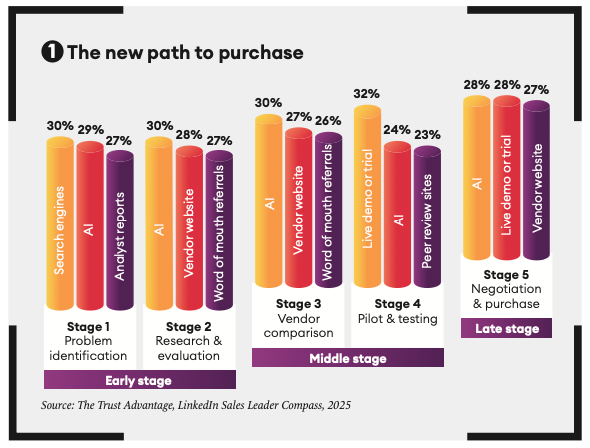
Inside that AI-mediated layer, two decisions are made about your brand, every day, in real time, and at scale. Some buyers discover you because AI surfaces your name in an answer, frames you credibly, and puts you on a shortlist you didn’t know you were being considered for. Others eliminate you for exactly the same reason, from exactly the same answer, because a competitor was framed more favorably or a concern in your story was amplified. Both happen in the same conversation. Neither produces a signal that your marketing or sales organization will ever see. You can be eliminated from consideration without ever knowing you were in it.
By the time a human enters your journey, the shape of the decision has already been set – not just in the impression formed by one buyer, but in the cumulative framing across thousands of conversations that are happening right now.
From SEO to GEO and now AEO
The demand generation discipline has to evolve. Search engine optimization (SEO) isn’t dead, but it is no longer enough. It was built for a world in which humans scanned a page of blue links and decided which one to click. That world is shrinking.
What’s replacing it is generative engine optimization (GEO) – the practice of shaping whether and how AI systems reference your brand when they synthesize answers for buyers. If SEO helped customers find you, GEO determines whether AI speaks for you. Close behind is agentic engine optimization (AEO), which prepares your brand, content and data for a world in which the entity evaluating you isn’t human at all. It’s an agent acting on a human’s behalf, with goals, budget and constraints already loaded.
Consider how Netflix’s recommendation engine changed the way films and shows are discovered. The “Because you watched” row is, in effect, an AI-generated answer to what to watch next. A film climbs, more people watch it, it climbs further, and a flywheel has started spinning outside of studio control. Studios spent a century perfecting how to create demand – the poster, the trailer, the opening weekend – and a recommendation engine quietly rewrote whose work gets found.
The same mechanism is now shaping how your company gets found. AI doesn’t invent. It assembles. It takes the fragments available – outdated positioning, a disgruntled review from 2019, a competitor’s white paper that frames the category in their favor, an executive interview with your CEO three CEOs ago – and builds a composite. That composite is what gets presented to your prospective buyer. Companies with a coherent point of view give AI good material to work with. Fragmented ones get a fragmented telling.
What good looks like
Adapting to this new reality starts with two moves that most leaders haven’t made. First, audit what AI says about your company. Go to the top five AI platforms and ask the questions your buyers are asking. Note what’s wrong, what’s missing, who you’re being compared to, and where you’re being excluded. Second, identify the three or four attributes you most want to be known for, and check whether AI is currently associating your brand with them. Most leaders assume they know the answer. They rarely do.
Here is the bigger mistake. Leaders assume their existing brand equity will carry over into AI-mediated discovery. It won’t. AI doesn’t weigh brand awareness the way humans do. It doesn’t care how many impressions you bought last quarter or how familiar your logo is to the buyer’s CFO. It cares about whether your story is coherent, consistent and present in the sources it draws from. Decades of marketing spend can produce a brand that AI still describes poorly.
Then comes the harder question – and the one most organizations haven’t answered. Who owns GEO? The work sits across marketing, communications, product marketing, analyst relations, data and IT. Most companies don’t have a home for it and that means no one is accountable for the answer AI gives about the company. Naming that accountability, before building the capability, is often the first real move.
In the Dark Funnel, visibility is binary. Either AI includes you in its synthesized answer, or you don’t exist. Traditional search optimization, paid media and website polish don’t guarantee inclusion. GEO does the work of making sure you’re in the room when the room is made of models.
When your buyer is an agent
Three stages of the B2B buyer journey are already routinely mediated by AI. Buyers use large language models (LLMs) to shortlist companies, narrowing a category of 50 down to three worth a conversation. They use LLMs to help write the RFP, which means the criteria you are being evaluated against were co-authored by a model trained on the public internet’s version of your industry. And then they run responses back through an LLM to decide who to go with.
The next stage is the most disruptive of all: agent-to-agent (A2A) negotiation. Enterprise platforms and brands are actively preparing for A2A commerce by making their data and workflows machine-readable and agent-ready. A buyer’s agent will go out into the market with goals, a budget and a negotiating strategy already in place. It will engage with seller agents, run scenarios, compare terms and stress-test claims. It will return to the human with a recommendation and, sometimes, a completed draft agreement for approval.
This changes the revenue function more than anything that has come before. Until now, AI has been shaping how buyers research and evaluate – but when agents negotiate, AI makes commercial decisions. The human moment moves from “decide who to buy from” to “approve or override what the agent already did.” Every earlier shift compressed the buyer journey, but this one compresses the revenue function itself.
It’s easy to dismiss this as a concern for tomorrow, but the infrastructure is already being built and the first transactions are already running. In late 2025, Stripe and OpenAI released the Agentic Commerce Protocol (ACP), an open standard that lets an AI agent complete a purchase from inside ChatGPT, end to end, on behalf of a human. Etsy merchants are already transacting on ACP. Over a million Shopify sellers, including Glossier, Skims and Spanx, are in the rollout. The proof that agents can execute purchases autonomously is no longer theoretical.
For B2B, the infrastructure is arriving just as quickly. Salesforce has announced Agentforce Commerce support for ACP, giving existing B2B organizations a path to expose their catalogs, pricing and policies in a form a seller agent can safely transact with external buyer agents over emerging protocols. Commercetools has published an explicit A2A blueprint for B2B, with agents handling quoting, replenishment and multi-stakeholder negotiation that traditional automation could never solve.
The companies that will compete well in this world are already preparing. Some are structuring their data so an agent can read it. Some are making their pricing logic legible, their terms machine-parsable. What they share is a recognition of where this is going. They are designing for the moment when the buyer isn’t the buyer.
Where growth is actually earned
If AI is doing the shortlisting, the comparing, the eliminating, and eventually the purchasing, a reasonable question is: what is the human still doing? The answer is, three things. They’re setting the outcome; choosing where to stay in the loop; and deciding how much to delegate.
Setting the outcome is the part no AI can do for you. The human still decides what budget to commit, what risk to take, which partner to trust with a strategic initiative, and which trade-offs matter when two options look equivalent on paper but feel different in the room.
Choosing where to stay in the loop is the new leadership skill, and the most under-examined of the three. When the loop is an agent, staying in it doesn’t mean reviewing every step. It means knowing which stages reward your attention and which you can safely let AI handle.
Leaders who default to how they used to oversee a deal – approving each stage, weighing in at each gate – will slow their organizations to a standstill. Leaders who disengage entirely will be surprised by outcomes they would never have signed off on. The judgment call is where your experience changes the answer. Everywhere else, the agent is probably faster and often better.
Deciding how much to delegate is the quietest of the three, and another factor that most leaders haven’t thought about. Every company will draw the line differently. Some will let agents negotiate routine purchases and keep humans on strategic ones. Others will delegate more, faster, for speed. Not making the choice is itself a choice – and the companies that don’t make it consciously will have it made for them. Sellers feel all of this first. They walk into meetings where the buyer already knows who they are, has already formed a view, and has already narrowed the field – and the seller has no visibility into how any of it happened. They are entering at confirmation, not discovery.
That changes the profile of the seller you hire, train and promote. Discovery skills matter less. Synthesis, credibility in the room and executive presence matter more. The demo, the proof of concept, the executive sponsor conversation and the reference call each now carry the weight that used to be distributed across the whole funnel.
This is a people strategy question as much as a sales enablement one, and most organizations have not yet rebuilt around it.
What’s left to tell
Businesses face a tough outlook and delivering top-line growth will keep getting harder. The Dark Funnel is a big reason why – yet most growth plans don’t yet account for its emergence.
The companies that do grow from here will do two things at once. They will invest in the mechanisms – GEO today, AEO next – that determine whether AI includes them at all. And they will raise the bar on the human moments that remain, because those moments are where growth actually gets earned now.
The buyer journey used to begin with a search. Increasingly, it begins with an answer. That answer was written before the buyer ever arrived, by systems that don’t know you but are already speaking for you.
Tiffani Bova is chief strategy and research officer at Futurum Group and author of GrowthIQ and The Experience Mindset
