
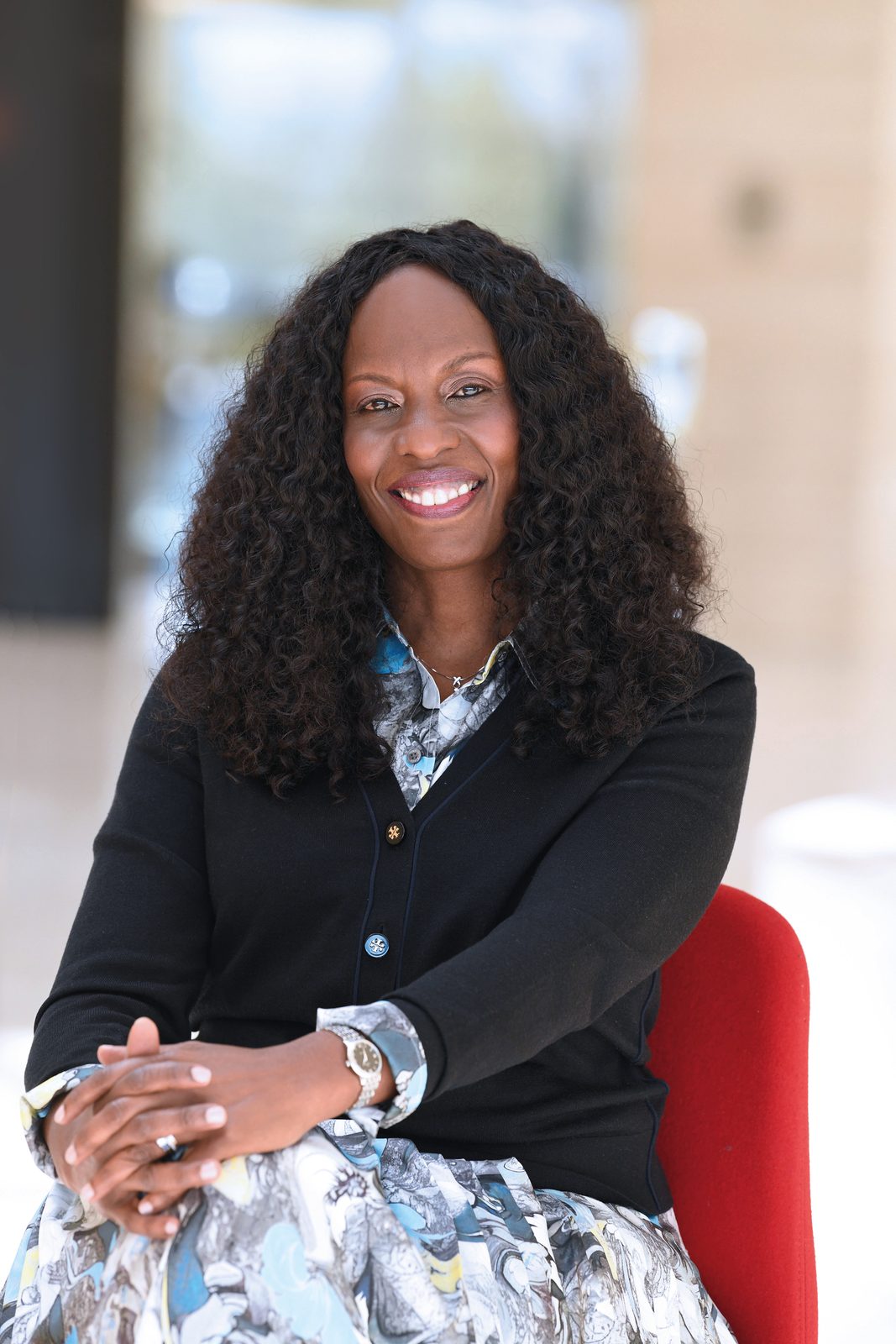
HR wasn’t part of Susan Muigai’s career plan, but an unexpected opening led her to her calling: helping others realize their potential
Writing: Patrick Woodman

As global head of people at Mastercard, Susan Muigai is chief people officer of one of the world’s most valuable companies. Yet she didn’t follow a straight path into HR leadership – far from it.
Muigai trained first as a lawyer, embarking on a career in commercial litigation before taking on risk management and audit responsibilities after joining Walmart. HR came later. It almost didn’t happen at all.
“I was a reluctant mover into the HR function,” admits Muigai. “I’m embarrassed to say this now, but I just didn’t see beyond the transactional side of HR.”
Fortunately, those around her saw things differently, and recognized her potential. “I had a mentor and a CEO who said to me, ‘We really think you’re built for the people function, and we think you should give it a go,'” she recalls. “They asked me to work in HR for six months while waiting for another role transition to happen.”
She decided to take the plunge. “I thought, ‘Why not? Let’s see what it’s all about.'”
It was February 2015 when Muigai took on the role of vice president, people, at Walmart Canada. It proved to be a career-defining experience. “I was blown away. I quickly realized I was sitting at the intersection of business, culture, leadership and growth,” she recalls. “Every single decision in the company was centered around its people: how those people enabled the business to land its strategy, what capabilities those people had to evolve the organization, what incentives we could provide for people to lean in where we were trying to grow, and how we could shift our culture to enable people to be their best – and do their best work.
“Those were things that truly inspired me. I came away seeing the many facets of HR and its criticality to the success of the business.”
Shared values
Muigai grew up in Kenya but has lived and worked around the world, including in Canada, India and the US. Those experiences have instilled a deep appreciation for the richness of different experiences and perspectives. “I think I’ve learned to approach different cultures with a sense of curiosity; to ask questions, to understand how their experience may differ from my own. The more global your role becomes, the more important that mindset becomes,” she reflects.
A global perspective has not simply revealed differences, however. “I’ve been struck by what we have in common – by what we share,” says Muigai. “People want meaningful work. They want to grow. They want to feel respected and valued. I’ve found those to be universal. While cultures may be different, those core human needs remain remarkably consistent.”
CHROs and senior leaders have the responsibility to respect people’s differences and their shared values simultaneously. “It’s about being sensitive to the nuances of what people may be going through, meeting them where they are and anchoring on the values of the organization. Mastercard’s culture plays a huge role in ensuring that we focus on what connects us.”
The interplay between personal and organizational spheres reflects an ever-present duality in the CHRO role. “A CHRO is both an advocate for the people and an advocate for the enterprise,” notes Muigai. “Sometimes, you’re trying to share an enterprise perspective with your workforce – but that perspective does not land if you haven’t listened to people and understood how to connect with them.”
Listening yields better solutions, but how can leaders be sure employees will voice their ideas when asked? Not every suggestion can be acted on, but leaders can give all ideas a fair hearing and treat colleagues with respect. “It’s about giving people confidence they’ve been heard – whether that means something will be done, and if not, the rationale for why things are the way they are,” says Muigai.
Honest and transparent communication are key. They are especially important amid change, when people feel vulnerable, defensive and hungry for information. “It’s very easy to lose trust if people do not believe you’re being authentic or open about what’s happening,” she points out. “My philosophy is: be as transparent as you can be.”
Situations arise where leaders cannot discuss plans in full, but that doesn’t mean they should say nothing. “I say, ‘Here’s what I can share, and what you can be certain about today. When there’s more to say, you’ll hear directly from me.”
Transparency extends to acknowledging the emotional dimension of change. “I believe it’s important to both be open about what your people might be feeling, and to share what I’m feeling as well,” says Muigai. Endemic uncertainty in the business environment affects everyone, whatever their seniority. “I tell my team I can provide clarity, but not certainty,” she shares. “With the pace of change in the world, certainty is impossible. Our role as leaders becomes about building trust and opening up communication, so people have clarity and confidence in our direction – even when the path forward isn’t fully clear.”
Developing talent, realizing potential
Another central facet of Muigai’s leadership is her passion for helping people grow. “I’ve become increasingly convinced that leadership is less about directing people and more about helping them realize their potential and contribute in ways that they may not have thought possible,” she explains. This conviction speaks directly to her core values as a leader. “I take the most joy when the teams I leave behind are better than when I found them.”
That outlook derives from a rounded appreciation of people in all their complexity. What happens outside the workplace inevitably shapes how people show up at work. “Life happens, as I like to say with my team. You never know where people are coming from when they meet you.”
That does not reduce leaders’ responsibility for driving performance standards. “There’s a balance of empathy and accountability,” she explains. “I care deeply about my people, my teams, the workforces that I oversee and their experiences. But I also believe in setting a high bar and helping teams strive for excellence.” They are two sides of the same coin. “I don’t think those two things are in conflict. They reinforce each other.”
The same care for people extends to supporting their development and helping them adapt to a fast-changing world. Mastercard is a platform for the world’s economies – leveraging evolving technologies to serve customers and operate with greater speed and efficiency. “We see technology as a partner, not necessarily as a replacement for roles,” she points out. Some of today’s jobs will disappear, but new ones will be created. “Our role as a company is to help our people see what those roles could be and help prepare them for that future.”
Companies are being challenged to chart new paths for developing talent. “We’re taking a skills-based approach to how we look at our talent and how we prepare them for the future,” says Muigai. That approach can reveal transferable capabilities. “That’s really helping our people understand how they can navigate their careers, enabling mobility across different roles and different business units, so they stay relevant for the future,” she explains.
Employees at all levels are confronting a new reality. “We’re all having to evolve, at a much faster pace than we’ve ever had to.” Adaptability and learning agility are core, says Muigai, their importance amplified by the pace of change. Everyone should ask themselves a fundamental question: “What skills do you need, regardless of where you’re at, regardless of level, to help you thrive in this new paradigm?”
Critical thinking, judgment and problem-solving skills are high on the list. “Ambiguity has become the new norm, so how do you help leaders and your workforce navigate that? How do you help them understand that you’re constantly making judgment calls with the information that you have?” A readiness to ask questions is essential. “It’s building that sense of curiosity, that sense of wanting to learn and understand more deeply. That’s critical to how we prepare folks for this future. People who can connect the dots across different contexts will thrive.”
Talent and opportunity
Preparing people for the future means recognizing another fundamental truth about ability and opportunity, something Muigai has seen clearly throughout her career. “Talent exists everywhere, but opportunity isn’t always distributed equally,” she points out. “It’s one of the reasons I’m passionate about creating access to development opportunities that help people grow, regardless of where they’re located.”
At Mastercard, Muigai can act on that insight on a global scale – across the organization and beyond. She recently returned to Kenya, where Mastercard works with the charity Hatua Network to expand opportunities for children from underprivileged backgrounds in education and as they transition into work. Mastercard provides grants and investments, and mentors – as well as supporting career fairs, offering internships and supporting access to graduate programs. Active outreach is important. “For these young people, in their circumstances, it can be difficult to dream big,” Muigai points out. “Helping support their potential is something we can do to give back.”
The partnership has evolved with several Hatua interns becoming full-time Mastercard employees. “We’ve been so gratified to see them thrive,” says Muigai. Many are themselves now mentors, volunteering to support the next generation – meaning the program’s impact will only grow as the years pass. “I can’t wait to see these young people become leaders in the future and see them support others facing similar challenges.”
Shaping the global future
Muigai’s enthusiasm about HR’s potential to drive impact is palpable. “The people function is navigating some of the world’s biggest challenges, including technology and its impact: how it’s transforming the workplace, how it’s transforming society, what that means for skills development, and what that means for organizational agility,” she argues.
“I couldn’t be more delighted to be at the center of all of those conversations – and to play a small part in helping shift where we are as a company today to where we want to be tomorrow.”
Empowering people to fulfill their potential. Building cultures that combine empathy with accountability. Recognizing the power of shared values as well as the richness derived from diverse perspectives. Navigating change via transparency, respect and trust. Muigai’s agenda for the people function will resonate with leaders everywhere.
CV: Susan Muigai
2025– Chief people officer, Mastercard
2023– Board member, strategic advisor, Coursera
2021–25 EVP, chief human resources officer, TransUnion
2017–21 Board of directors, Massmart Holdings, Inc. & Walmart Foundation
2015–21 Senior people leadership roles, Canada and international, Walmart
2005–15 Risk, audit, legal and real estate roles, Canada, India and US, Walmart
2000–05 Associate, commercial litigation group, Lang Michener
Patrick Woodman is editor of Dialogue
Images: Mastercard/Duke CE
